Du Sable, Jean Baptiste Point, Homesite
Also known as: Pioneer Court

Why it's listed
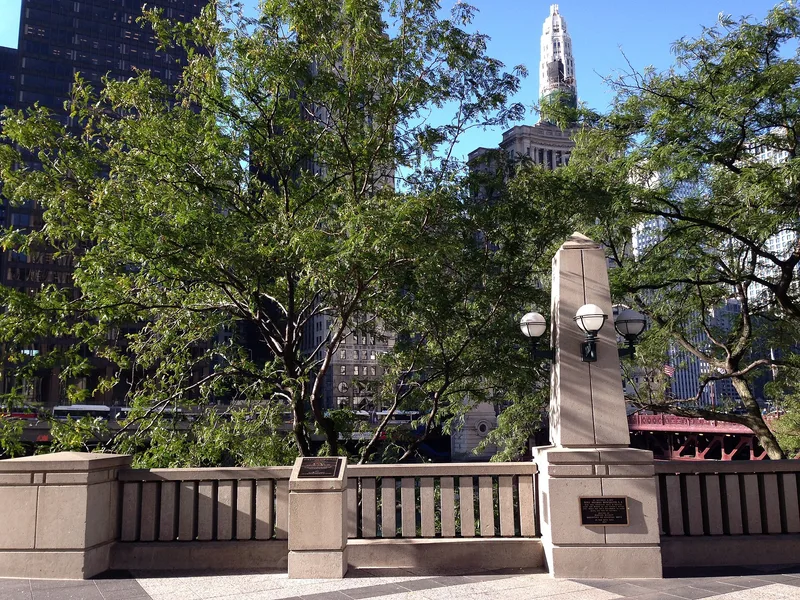
Pioneer Court, a public plaza at 401 North Michigan Avenue in Chicago, occupies part of the land where Jean Baptiste Point Du Sable built a trading post and home before 1779. Du Sable, born in Haiti in 1745, was a fur trader and farmer who settled at the Chicago portage, which linked the Great Lakes and the Mississippi River. His log house measured twenty-two by forty feet and was surrounded by barns, a mill, a bakehouse and other outbuildings. He sold the post in 1800 to Jean Lalime. The nomination describes him as the first permanent non-Indian settler and founder of Chicago, and as an example of Afro-American contributions to the country's early development. Today the site is a red-brick plaza of about 100,000 square feet, dedicated in 1965, with planters, a fountain naming Chicago pioneers, and bronze plaques recounting the history of the site, including its later resident John Kinzie.
Significance in brief: The site is where Du Sable, described as the first permanent non-Indian settler of Chicago, set up a trading post before 1779 at the Chicago portage. The nomination argues that this laid the foundation for the city's growth and represents Afro-American contributions to the nation's early economic development.
Machine-generated summary. This summary was generated by a language model from the official nomination document and has not been reviewed line by line by an editor. It may contain errors. Check the source document before relying on any detail. Source: nomination document (PDF) · National Archives catalog entry. NRHP reference 76000690, listed May 11, 1976. Summary generated October 2026 (model claude-sonnet-5-5, prompt v1.0-2026-10-29, confidence medium).
Key facts
| Address | 401 N. Michigan Ave., Chicago |
|---|---|
| County | Cook County |
| Listed | May 11, 1976 |
| Reference number | 76000690 |
| Resource type | Site |
| Period of significance | 1800-1899 (specific date c. 1779, establishment of Du Sable trading post) |
| Areas of significance | Commerce, Black, Exploration/Settlement |
| Level of significance | National |
| National Historic Landmark | Yes, designated May 11, 1976 |
| Status (as stated in the nomination) | Condition listed as excellent and original site; the plaza is occupied and open to public use, with plaques marking the site's history. |
| Acreage | 0.9 |
| Within district | Michigan-Wacker Historic District |
| Coordinates | 41.88969, -87.62346 (NPS GIS) |
What listing means for this property
Sites (archaeological sites, battlefields, landscapes) are often listed with a restricted address to protect them from looting or disturbance. Listing is honorary for private owners; federal undertakings on or near the site go through Section 106 review, and state laws may protect burials and artefacts regardless of listing.
General information, not legal or tax advice. Rules change; confirm with your State Historic Preservation Office or a qualified adviser.
Sources and further reading
- National Park Service, National Register of Historic Places database (snapshot May 2026), reference 76000690.
- Nomination form (PDF, National Archives) — catalog entry
- Wikipedia article (used for cross-checking only; text not reproduced here)
- Wikidata Q6170210
- This listing as JSON
Last updated October 2026. Found an error? See the editorial policy for how to report it.