Woodland Cemetery

Why it's listed
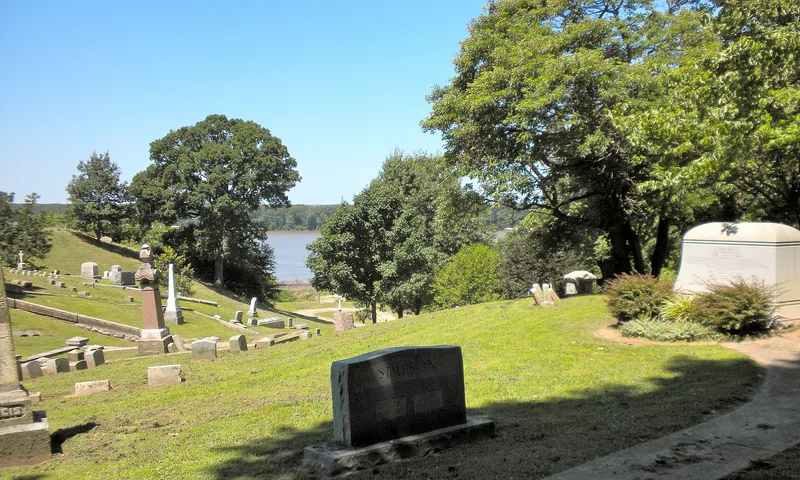
Woodland Cemetery occupies slightly more than 43 acres of hills, ravines and mature trees on limestone bluffs roughly 100 feet above the Mississippi River in southwestern Quincy, Illinois. Quincy's founder, John Wood, laid it out in 1846 in the tradition of Mount Auburn, and it follows the rural cemetery model. Nineteen irregular blocks, platted between 1846 and 1928, follow the natural terrain, and the drives and landforms remain essentially as first laid out. The grounds contain a circa 1916 Sexton's House, a 1927 Classical Revival granite mausoleum, several family vaults, and many carved monuments. The Rogers vault of 1875-76, built of Vermont marble, and the 1867 Soldiers Monument by sculptor Cornelius G. Volk are among the best known. The cemetery became Quincy's principal burial ground and a favored place for Victorian-era visitors. It is listed as a district for its landscape design, its surviving topography, and its funerary architecture and sculpture from 1846 to 1951.
Significance in brief: The nomination presents Woodland as a representative example of the rural cemetery movement, with its original hilly, wooded topography and drive and block layout largely intact. It was the city's principal burial ground and holds notable vaults, a mausoleum, and monuments, including the Civil War Soldiers Monument and the Rogers vault. Its period of significance is 1846-1951.
Machine-generated summary. This summary was generated by a language model from the official nomination document and has not been reviewed line by line by an editor. It may contain errors. Check the source document before relying on any detail. Source: nomination document (PDF) · National Archives catalog entry. NRHP reference 02000096, listed March 1, 2002. Summary generated October 2026 (model claude-sonnet-5-5, prompt v1.0-2026-10-29, confidence medium).
Key facts
| Address | 1020 S. Fifth St., Quincy |
|---|---|
| County | Adams County |
| Listed | March 1, 2002 |
| Reference number | 02000096 |
| Resource type | District |
| Period of significance | 1846-1951 |
| Architect / builder | John Wood (landscape plan); J. R. Bunting (Rogers vault); Cornelius G. Volk (Soldiers Monument); Ernest Harvey Chatten (1905 gate) |
| Architectural style | Late Gothic Revival; Classical Revival |
| Areas of significance | Landscape Architecture, Architecture, Art |
| Level of significance | Local |
| Status (as stated in the nomination) | Still in use as a cemetery; some vaults are eroded or vandalized, and the original topography remains largely intact. |
| Acreage | 45 |
| Coordinates | 39.92068, -91.40992 (NPS GIS) |
What listing means for this property
This is a historic district. Buildings within its boundary are either contributing (they add to the district's significance) or non-contributing. Owners of contributing income-producing buildings can claim the 20% federal rehabilitation tax credit; homeowners should look at state credits. National Register districts impose no design review by themselves; a local historic district ordinance, if one exists, does (the difference explained).
General information, not legal or tax advice. Rules change; confirm with your State Historic Preservation Office or a qualified adviser.
Sources and further reading
- National Park Service, National Register of Historic Places database (snapshot May 2026), reference 02000096.
- Nomination form (PDF, National Archives) — catalog entry
- Wikipedia article (used for cross-checking only; text not reproduced here)
- Wikidata Q21188032
- This listing as JSON
Last updated October 2026. Found an error? See the editorial policy for how to report it.