Sands Hill Historic District
Also known as: Elizabethtown Historic District
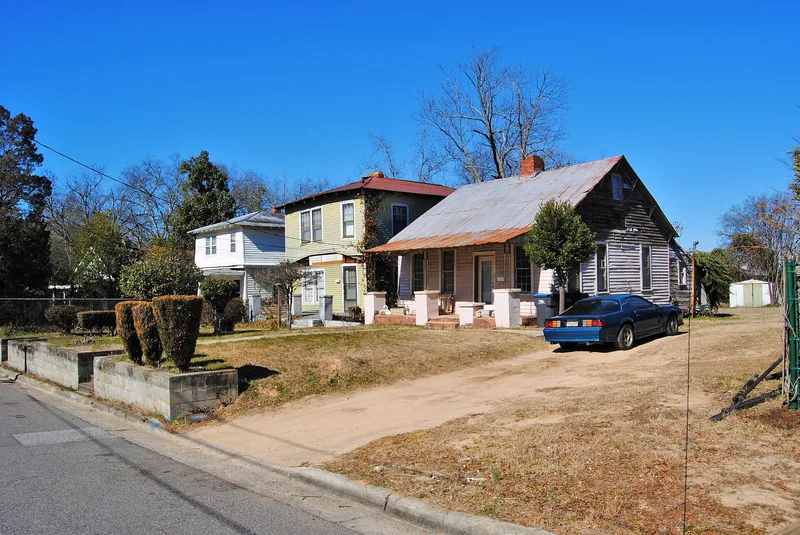

Why it's listed
Sand Hills is a densely settled African-American neighborhood in western Augusta, laid out on an incomplete grid with long, narrow lots. It began soon after the Civil War, when freed people settled land once owned by white Summerville families and worked as domestics and laborers for them. The district holds 335 contributing resources, including a cemetery shown on an 1874 map, shotgun houses, cottages, bungalows and larger two-story Craftsman homes. Augusta's 1913 racial zoning ordinance brought more residents, among them middle-class families who built larger houses in popular styles. Corner stores, several churches such as Cumming Grove Baptist and Rock of Ages C.M.E., and the 1936 Weed School, built with public works funds, served the community. Swept yards and tree-lined streets with uniform setbacks reflect historic landscape traditions. The district was recognized for its architecture, African-American heritage, planning and landscape, with a period of significance from 1874 to 1947.
Significance in brief: The district is argued to have statewide significance in architecture, African-American ethnic heritage, community planning and development, and landscape architecture. It preserves a wide range of house types and styles, commercial and institutional buildings, a gridiron plan with narrow lots, and swept yard and New South landscapes. Its growth was tied to Summerville's white households and to Augusta's 1913 racial zoning ordinance.
Machine-generated summary. This summary was generated by a language model from the official nomination document and has not been reviewed line by line by an editor. It may contain errors. Check the source document before relying on any detail. Source: nomination document (PDF) · National Archives catalog entry. NRHP reference 97000754, listed July 9, 1997. Summary generated October 2026 (model claude-sonnet-5-5, prompt v1.0-2026-10-29, confidence high).
Key facts
| Address | Roughly bounded by Monte Sano and North View Aves., Mount Auburn St., Johns Rd., and Augusta Country Club., Augusta |
|---|---|
| County | Richmond County |
| Listed | July 9, 1997 |
| Reference number | 97000754 |
| Resource type | District |
| Period of significance | 1874-1947 |
| Architect / builder | Unknown |
| Architectural style | Colonial Revival, Dutch Colonial Revival, Spanish Colonial Revival, Tudor Revival, Craftsman, Folk Victorian, Minimal Traditional, and vernacular types including Georgian Cottage, Central Hall, Shotgun, Bungalow, Gabled Ell Cottage and Pyramid Cottage |
| Criteria |
|
| Areas of significance | Architecture, Black, Community Planning and Development, Landscape Architecture |
| Level of significance | State |
| Status (as stated in the nomination) | Current functions listed include single dwellings, general store, school, religious facility and cemetery; the neighborhood remains mostly African American. |
| Acreage | 231 |
| Coordinates | 33.48320, -82.01997 (NPS GIS) |
What listing means for this property
This is a historic district. Buildings within its boundary are either contributing (they add to the district's significance) or non-contributing. Owners of contributing income-producing buildings can claim the 20% federal rehabilitation tax credit; homeowners should look at state credits. National Register districts impose no design review by themselves; a local historic district ordinance, if one exists, does (the difference explained).
General information, not legal or tax advice. Rules change; confirm with your State Historic Preservation Office or a qualified adviser.
Sources and further reading
- National Park Service, National Register of Historic Places database (snapshot May 2026), reference 97000754.
- Nomination form (PDF, National Archives) — catalog entry
- Wikipedia article (used for cross-checking only; text not reproduced here)
- Wikidata Q75335801
- This listing as JSON
Last updated October 2026. Found an error? See the editorial policy for how to report it.