Broadway Theater and Commercial District

Why it's listed
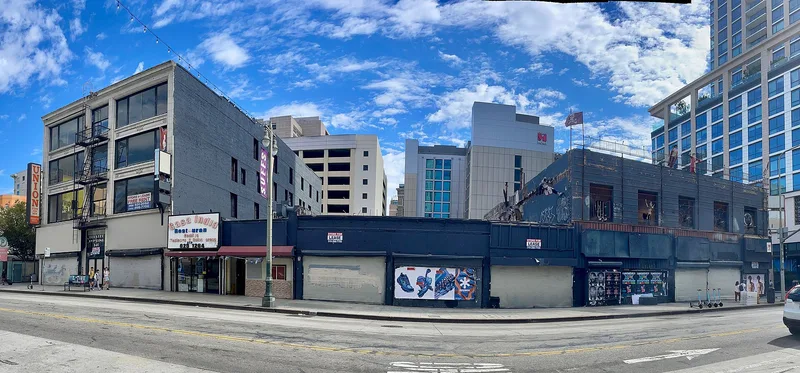
Broadway between Third and Ninth Streets in downtown Los Angeles forms a six-block district of commercial towers, department stores and theaters, most built between 1894 and 1931. The buildings are in varied condition, and several have gained new facades since. Architectural styles range from Italianate and Romanesque to Classical, Spanish and French Renaissance, Gothic Revival, Art Deco and Moderne. Notable examples include the Bradbury Building by George Wyman, the Eastern Columbia Building by Claude Beelman, the Orpheum Theater, and the Los Angeles Theater by S. Charles Lee. Supporting statements describe Broadway as the first and largest picture-palace row in southern California. They note the Million Dollar Theatre as the city's first movie palace and the Tower Theatre as an early user of centralized air conditioning. Advocates urged listing a full district rather than isolated landmarks, arguing that scattered recognition would leave plaques marking buildings that could not survive redevelopment.
Significance in brief: The district is a concentration of commercial buildings and movie and vaudeville theaters in many styles, including Classical, Art Deco, Moderne and Spanish and French Renaissance. Supporting material describes Broadway as the first and largest picture-palace row in southern California. It also notes early theater firsts such as the Million Dollar Theatre as the first movie palace in Los Angeles. Supporters argued that only a true district could withstand urban redevelopment.
Machine-generated summary. This summary was generated by a language model from the official nomination document and has not been reviewed line by line by an editor. It may contain errors. Check the source document before relying on any detail. Source: nomination document (PDF) · National Archives catalog entry. NRHP reference 79000484, listed May 9, 1979. Summary generated October 2026 (model claude-sonnet-5-5, prompt v1.0-2026-10-29, confidence medium).
Key facts
| Address | 300--849 S. Broadway, Los Angeles |
|---|---|
| County | Los Angeles County |
| Listed | May 9, 1979 |
| Reference number | 79000484 |
| Resource type | District |
| Architect / builder | Multiple architects, including George Wyman, John Parkinson, Parkinson & Bergstrom, Morgan & Walls, S. Charles Lee, Walker & Eisen, Claude Beelman, G. Albert Lansburgh and A.C. Martin |
| Architectural style | Varied: Classical and Commercial styles, Art Deco, Moderne, Romanesque, Italianate, Spanish and French Renaissance, Gothic Revival |
| Areas of significance | Commerce, Architecture |
| Level of significance | State |
| Status (as stated in the nomination) | Buildings are in varying condition and degree of alteration; some have new facades, and the Bradbury Building is completely restored. The form marks the district as occupied and altered, with some parking lots and a few post-1930 structures. |
| Acreage | 28.1 |
| Within district | Spring Street Financial District |
| Coordinates | 34.04653, -118.25218 (NPS GIS) |
What listing means for this property
This is a historic district. Buildings within its boundary are either contributing (they add to the district's significance) or non-contributing. Owners of contributing income-producing buildings can claim the 20% federal rehabilitation tax credit; homeowners should look at state credits. National Register districts impose no design review by themselves; a local historic district ordinance, if one exists, does (the difference explained).
General information, not legal or tax advice. Rules change; confirm with your State Historic Preservation Office or a qualified adviser.
Sources and further reading
- National Park Service, National Register of Historic Places database (snapshot May 2026), reference 79000484.
- Nomination form (PDF, National Archives) — catalog entry
- Wikipedia article (used for cross-checking only; text not reproduced here)
- Wikidata Q4972516
- This listing as JSON
Last updated October 2026. Found an error? See the editorial policy for how to report it.