Spring Street Financial District

Why it's listed
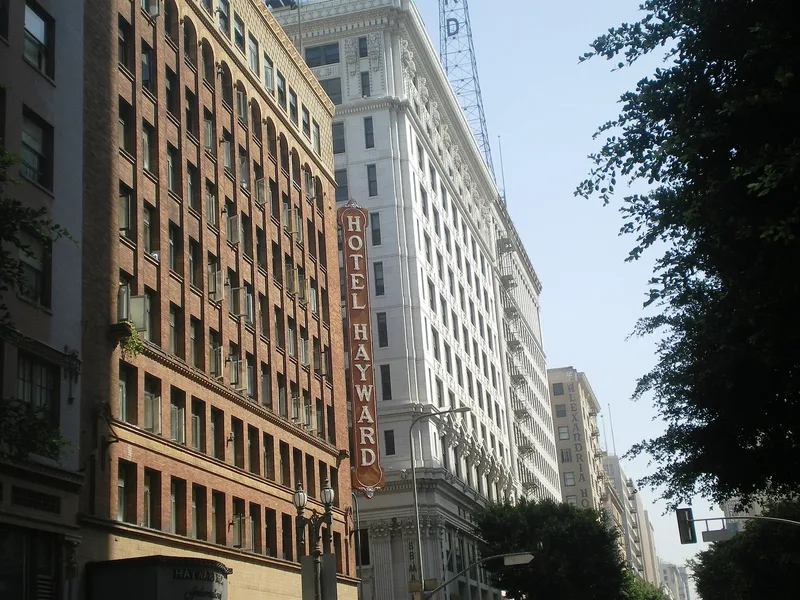
South Spring Street in downtown Los Angeles holds a concentrated group of 26 significant buildings, most put up between about 1900 and the mid-1930s to house banks, insurance companies and investment firms. The stretch, just over three city blocks, was long called the "Wall Street of the West." Development moved south from Fourth Street after the Continental Building, regarded as the city's first skyscraper, and the Hellman Building began the push in 1902. Later additions included the Security Building, Rowan Building, Crocker Bank, the Title Insurance and Trust Building, and the Pacific Stock Exchange. Architects such as John Parkinson, Parkinson & Bergstrom, and Morgan, Walls & Morgan designed many of them. Classical, Commercial and Moderne designs with restrained ornament and similar heights give the street a uniform look. Banks began moving west toward Wilshire Boulevard and Figueroa Street in the 1960s, leaving many buildings partly vacant. Several later structures are noted as intrusions.
Significance in brief: Spring Street was known as the "Wall Street of the West" and documents the economic activity of Los Angeles and Southern California. Its banks, insurance companies and stock exchange form a nearly homogeneous streetscape in Classical, Commercial and Moderne styles that conveys stability and permanence. The district was complete by 1931.
Machine-generated summary. This summary was generated by a language model from the official nomination document and has not been reviewed line by line by an editor. It may contain errors. Check the source document before relying on any detail. Source: nomination document (PDF) · National Archives catalog entry. NRHP reference 79000489, listed August 10, 1979. Summary generated October 2026 (model claude-sonnet-5-5, prompt v1.0-2026-10-29, confidence medium).
Key facts
| Address | 354--704 S. Spring St., Los Angeles |
|---|---|
| County | Los Angeles County |
| Listed | August 10, 1979 |
| Reference number | 79000489 |
| Resource type | District |
| Period of significance | 1902 |
| Architect / builder | various |
| Architectural style | Classical, Commercial and Moderne styles |
| Areas of significance | Economics, Architecture |
| Level of significance | State |
| Status (as stated in the nomination) | Most buildings are in very good condition, although many are partially vacant; several banks left from the 1960s onward and city redevelopment plans were under way. |
| Acreage | 14.6 |
| Coordinates | 34.04677, -118.25062 (NPS GIS) |
What listing means for this property
This is a historic district. Buildings within its boundary are either contributing (they add to the district's significance) or non-contributing. Owners of contributing income-producing buildings can claim the 20% federal rehabilitation tax credit; homeowners should look at state credits. National Register districts impose no design review by themselves; a local historic district ordinance, if one exists, does (the difference explained).
General information, not legal or tax advice. Rules change; confirm with your State Historic Preservation Office or a qualified adviser.
Sources and further reading
- National Park Service, National Register of Historic Places database (snapshot May 2026), reference 79000489.
- Nomination form (PDF, National Archives) — catalog entry
- Wikipedia article (used for cross-checking only; text not reproduced here)
- Wikidata Q7580685
- This listing as JSON
Last updated October 2026. Found an error? See the editorial policy for how to report it.