Williamsburg Historic District

Why it's listed
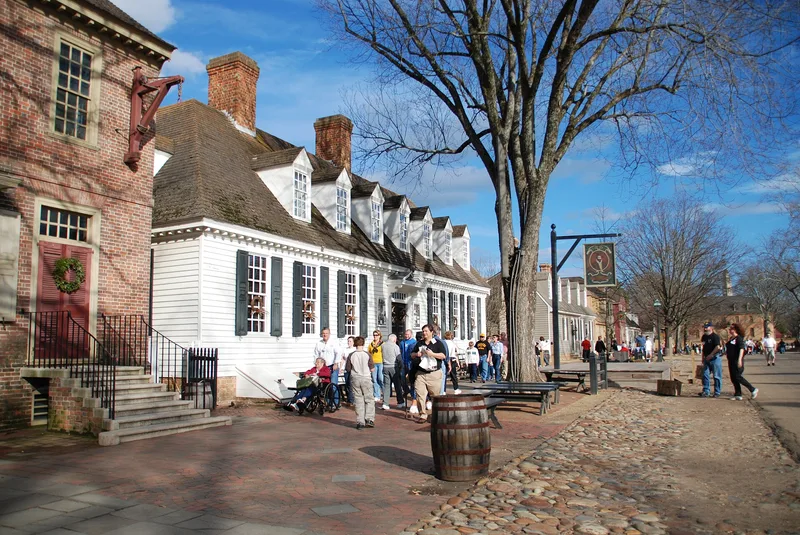
Williamsburg Historic District preserves the core of Virginia's colonial capital, which served in that role from 1699 until 1779, when government moved to Richmond. Restoration began in 1927 under John D. Rockefeller, Jr. About 600 buildings were removed, roughly 100 were restored and about 350 were reconstructed on their original sites. Restored buildings include the Public Magazine, Ludwell-Paradise House, Old Courthouse, Bruton Parish Church and George Wythe House. Reconstructions include the Capitol, Raleigh Tavern and Governor's Palace. Old College Yard anchors the western end of Duke of Gloucester Street. The district covers about 173 acres, following the 1966 Historic Area boundary. In the 18th century, Patrick Henry delivered his Stamp Act speeches here, George Mason wrote the Virginia Declaration of Rights, and the Virginia Constitution of 1776 was drawn up. George Washington, Thomas Jefferson and George Wythe also studied, taught or served in office here. The restoration remains a benchmark for historical research.
Significance in brief: Williamsburg was the capital of colonial Virginia and a political and cultural center for about eighty years, where future Revolutionary leaders studied, taught or served. Key events include Patrick Henry's speeches, George Mason's Declaration of Rights and the Virginia Constitution of 1776. The restoration is also regarded as a standard of scholarly historic restoration.
Machine-generated summary. This summary was generated by a language model from the official nomination document and has not been reviewed line by line by an editor. It may contain errors. Check the source document before relying on any detail. Source: nomination document (PDF) · National Archives catalog entry. NRHP reference 66000925, listed October 15, 1966. Summary generated October 2026 (model claude-sonnet-5-5, prompt v1.0-2026-10-29, confidence high).
Key facts
| Address | Bounded by Francis, Waller, Nicholson, N. England, Lafayette, and Nassau Sts., Williamsburg (Independent City) |
|---|---|
| County | Williamsburg |
| Listed | October 15, 1966 |
| Reference number | 66000925 |
| Resource type | District |
| Period of significance | 1699-1779 |
| Architectural style | Early Georgian |
| Areas of significance | Conservation, Politics/Government, Architecture |
| Level of significance | National |
| National Historic Landmark | Yes, designated October 9, 1960 |
| Status (as stated in the nomination) | Condition listed as excellent but altered, on its original site; the district is occupied, open year-round to the public, and used for commercial, educational, entertainment and museum purposes. |
| Acreage | 173 |
| Within district | Merchants Square and Resort Historic District |
| Coordinates | 37.27202, -76.69728 (NPS GIS) |
What listing means for this property
This is a historic district. Buildings within its boundary are either contributing (they add to the district's significance) or non-contributing. Owners of contributing income-producing buildings can claim the 20% federal rehabilitation tax credit; homeowners should look at state credits. National Register districts impose no design review by themselves; a local historic district ordinance, if one exists, does (the difference explained).
General information, not legal or tax advice. Rules change; confirm with your State Historic Preservation Office or a qualified adviser.
Sources and further reading
- National Park Service, National Register of Historic Places database (snapshot May 2026), reference 66000925.
- Nomination form (PDF, National Archives) — catalog entry
- Wikipedia article (used for cross-checking only; text not reproduced here)
- Wikidata Q841700
- This listing as JSON
Last updated October 2026. Found an error? See the editorial policy for how to report it.