Wythe House

Why it's listed
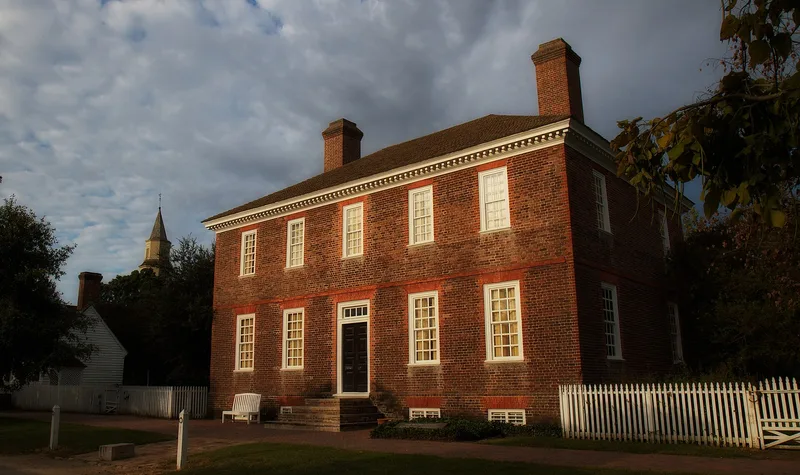
Overlooking Palace Green beside Bruton Parish Church in Williamsburg, this two-story brick house measures about 54 by 39 feet and follows the standard eighteenth-century double-pile plan, with a central hall and four rooms. Built around 1750 by planter Richard Talliaferro, it has Flemish bond brickwork above the water table, rubbed and gauged brick detailing, and a low hipped roof. Its design is based on a plate in William Salmon's Palladio Londinensis of 1734. The interior is plain apart from an open-string walnut stair in the central hall. George Wythe lived here from about 1755 until 1791. He sat in the House of Burgesses, served as mayor, signed the Declaration of Independence and taught law at the College of William and Mary, where his students included Thomas Jefferson, John Marshall and James Monroe. Bruton Parish restored the house between 1926 and 1931, and Colonial Williamsburg acquired it in 1937. The house is described as one of the nation's finest Georgian town houses.
Significance in brief: The nomination calls it Williamsburg's most handsome colonial house and one of Virginia's and the nation's finest Georgian town houses, noted for its lines and brickwork. It was home to George Wythe from about 1755 to 1791. Wythe was a signer of the Declaration of Independence and the first professor of law in an American college, and his students included Jefferson, Marshall and Monroe.
Machine-generated summary. This summary was generated by a language model from the official nomination document and has not been reviewed line by line by an editor. It may contain errors. Check the source document before relying on any detail. Source: nomination document (PDF) · National Archives catalog entry. NRHP reference 70000866, listed April 15, 1970. Summary generated October 2026 (model claude-sonnet-5-5, prompt v1.0-2026-10-29, confidence high).
Key facts
| Address | W side of the Palace Green, Williamsburg (Independent City) |
|---|---|
| County | Williamsburg |
| Listed | April 15, 1970 |
| Reference number | 70000866 |
| Resource type | Building |
| Period of significance | 18th Century |
| Architect / builder | Richard Talliaferro (builder, c. 1750) |
| Architectural style | Georgian town house, double-pile central hall plan |
| Areas of significance | Politics/Government, Architecture |
| Level of significance | National |
| National Historic Landmark | Yes, designated April 15, 1970 |
| Status (as stated in the nomination) | Maintained in excellent condition by Colonial Williamsburg, Inc.; restored 1926-1931 and changed very little. Outbuildings are reconstructed. |
| Acreage | 1 |
| Within district | Williamsburg Historic District |
| Coordinates | 37.27204, -76.70277 (NPS GIS) |
What listing means for this property
National Register listing is honorary for a privately owned home: it does not by itself restrict what an owner may do with their own money, and it does not require public access. Restrictions come from local landmark or historic-district ordinances, which are separate (how they differ).
Owner-occupied houses are not eligible for the 20% federal rehabilitation tax credit, which applies to income-producing buildings, but many states offer credits for homeowners. Listing also opens the door to preservation easements and to buying a plaque. Start with what listing means for homeowners, renovating a listed house and selling one.
General information, not legal or tax advice. Rules change; confirm with your State Historic Preservation Office or a qualified adviser.
Sources and further reading
- National Park Service, National Register of Historic Places database (snapshot May 2026), reference 70000866.
- Nomination form (PDF, National Archives) — catalog entry
- Wikipedia article (used for cross-checking only; text not reproduced here)
- Wikidata Q8040653
- This listing as JSON
Last updated October 2026. Found an error? See the editorial policy for how to report it.