Phoenix Bank of Nansemond
Also known as: DHR File No. 133-34

Why it's listed
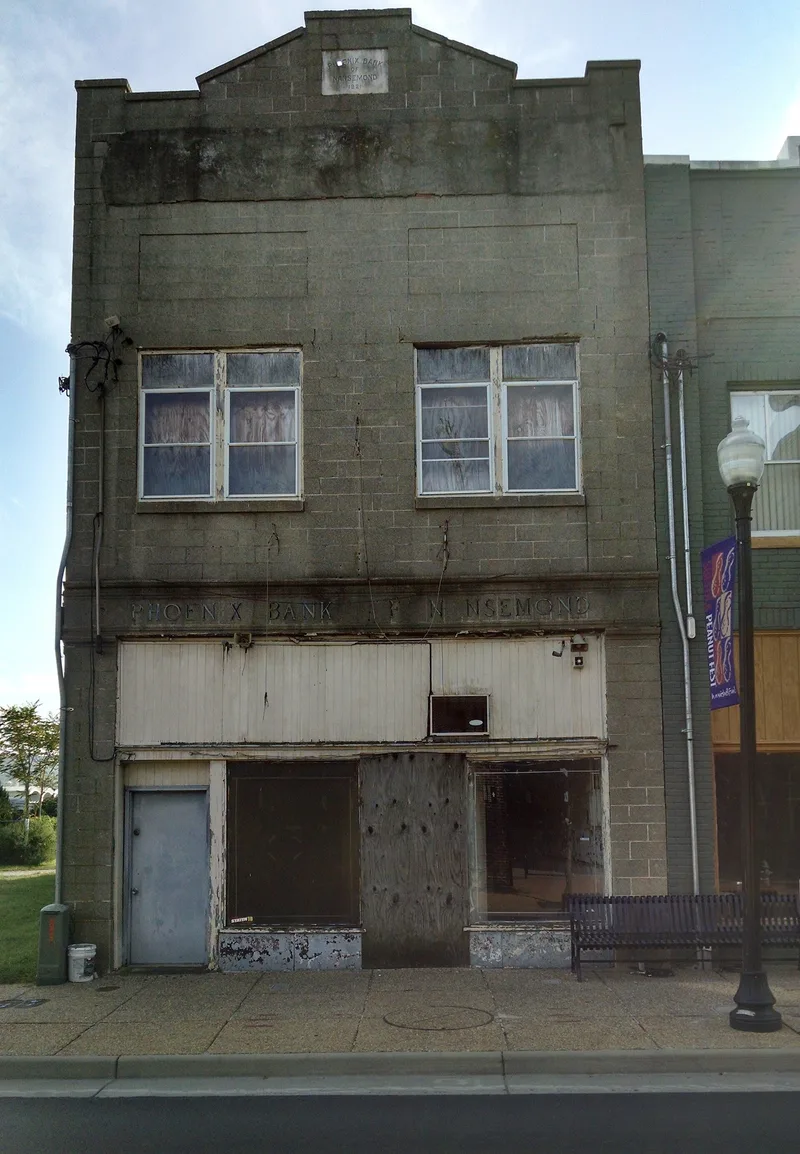
Built in 1921 on East Washington Street in Suffolk, Virginia, this two-story brick building housed the Phoenix Bank of Nansemond. Its false front of gravel-faced cement block carries a metal frieze, a decorative cornice on scrolled brackets and a stepped parapet with a plaque dated 1921. The bank was organized in 1919 by a group of black entrepreneurs, with physician Dr. W. T. Fuller as first president, and later led by J. W. Richardson. It served black farmers and laborers in Suffolk and surrounding Nansemond County, and it was the only black-owned bank in the city. It operated until 1931, when it closed for lack of depositors. The building was listed because it reflects how black communities built their own financial institutions during segregation, when white banks would not extend credit. The first floor now serves as a restaurant, and little of the original interior survives, though the exterior remains largely intact.
Significance in brief: The nomination argues the building represents black commerce in southeastern Virginia. The bank was founded by black entrepreneurs in 1919 to serve black farmers and laborers in Suffolk and Nansemond County, and it was the only black bank in Suffolk. It is presented as a symbol of economic self-help during segregation.
Machine-generated summary. This summary was generated by a language model from the official nomination document and has not been reviewed line by line by an editor. It may contain errors. Check the source document before relying on any detail. Source: nomination document (PDF) · National Archives catalog entry. NRHP reference 90002159, listed January 24, 1991. Summary generated October 2026 (model claude-sonnet-5-5, prompt v1.0-2026-10-29, confidence high).
Key facts
| Address | 339 E. Washington St., Suffolk (Independent City) |
|---|---|
| County | Suffolk |
| Listed | January 24, 1991 |
| Reference number | 90002159 |
| Resource type | Building |
| Period of significance | 1921-1931 |
| Architectural style | Late 19th and Early 20th Century American Movements: Commercial style |
| Criteria |
|
| Areas of significance | Commerce, Black |
| Level of significance | Local |
| Status (as stated in the nomination) | The first floor is used as a restaurant, and the two second-floor apartments are described as empty. The exterior is largely unchanged except for the east wall and the entrance doors, and almost no original bank interior remains. |
| Acreage | 0.9 |
| Coordinates | 36.72672, -76.57841 (NPS GIS) |
What listing means for this property
For an income-producing building, listing (individually or as a contributing building in a district) is the gateway to the 20% federal rehabilitation tax credit on qualified rehabilitation costs, often stackable with state credits. Work claiming the credit must follow the Secretary of the Interior's Standards and be approved in advance.
Listing does not restrict a private owner acting without federal money or permits; where federal funding or licensing is involved, Section 106 review applies.
General information, not legal or tax advice. Rules change; confirm with your State Historic Preservation Office or a qualified adviser.
Sources and further reading
- National Park Service, National Register of Historic Places database (snapshot May 2026), reference 90002159.
- Nomination form (PDF, National Archives) — catalog entry
- Wikipedia article (used for cross-checking only; text not reproduced here)
- Wikidata Q16898349
- This listing as JSON
Last updated October 2026. Found an error? See the editorial policy for how to report it.