Valley Railroad Bridge

Why it's listed
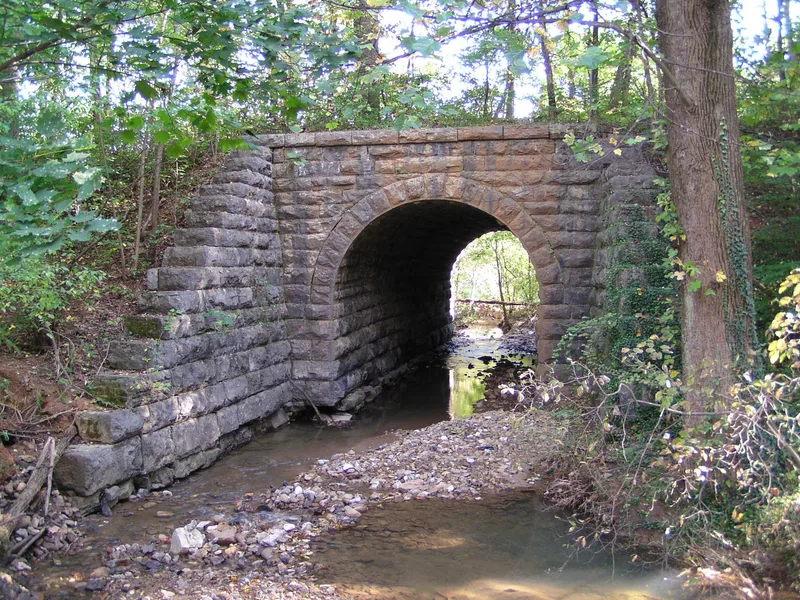
Built in 1873 over Gish Branch in Salem, Virginia, this limestone bridge was meant to carry the Valley Railroad, a planned 113-mile line linking Harrisonburg to Salem. It is a semicircular vaulted tunnel through an earthen embankment, 69 feet long with a 12-foot span, and its keystones sit 15 feet above the creek. The roughly dressed, coursed stone, thought to be quarried nearby, was laid by local craftsmen. Thomas K. Menifee supervised the 14-mile section that included the bridge, under the Mason Syndicate. Work stopped in late 1874 after the Panic of 1873 left the railroad insolvent, so no trains ever crossed. The bridge survives in good condition and is the largest of three remaining Menifee arch structures; the others and much of the roadbed were lost to road widening and residential development. It is recognized for its engineering and stonework and as a reminder of post-Civil War railroad ambitions. It currently has no public access.
Significance in brief: The bridge is significant under Criterion C in the area of Architecture as a well-preserved example of fine 19th-century stone masonry and engineering. It is the largest of three remaining arch structures built by Menifee and the most impressive in the area. The railroad was never completed to Salem, so the bridge never carried trains.
Machine-generated summary. This summary was generated by a language model from the official nomination document and has not been reviewed line by line by an editor. It may contain errors. Check the source document before relying on any detail. Source: nomination document (PDF) · National Archives catalog entry. NRHP reference 09000617, listed August 12, 2009. Summary generated October 2026 (model claude-sonnet-5-5, prompt v1.0-2026-10-29, confidence high).
Key facts
| Address | 1002 Newman Dr., Salem |
|---|---|
| County | Salem |
| Listed | August 12, 2009 |
| Reference number | 09000617 |
| Resource type | Structure |
| Period of significance | 1873 |
| Architect / builder | Menifee, Thomas K., engineer, The Mason Syndicate, builders |
| Architectural style | No style |
| Criteria |
|
| Areas of significance | Architecture |
| Level of significance | Local |
| Status (as stated in the nomination) | Not in use; the site has no roads or public access, though public access and interpretive signage are hoped for. |
| Acreage | 0.9 |
| Coordinates | 37.30411, -80.04491 (NPS GIS) |
What listing means for this property
For a publicly owned building or structure, listing mainly matters when federal funds, permits or licences are involved: projects then go through Section 106 review so effects on the property are considered. Listing also strengthens applications for preservation grants and, for leased income-producing uses, can enable the federal rehabilitation tax credit.
Noted as vacant in the nomination. Nomination documents can be decades old; current status may differ. If you are considering buying an empty listed property, read the due-diligence checklist.
General information, not legal or tax advice. Rules change; confirm with your State Historic Preservation Office or a qualified adviser.
Sources and further reading
- National Park Service, National Register of Historic Places database (snapshot May 2026), reference 09000617.
- Nomination form (PDF, National Archives) — catalog entry
- Wikipedia article (used for cross-checking only; text not reproduced here)
- Wikidata Q16902510
- This listing as JSON
Last updated October 2026. Found an error? See the editorial policy for how to report it.