Hollywood Cemetery

Why it's listed
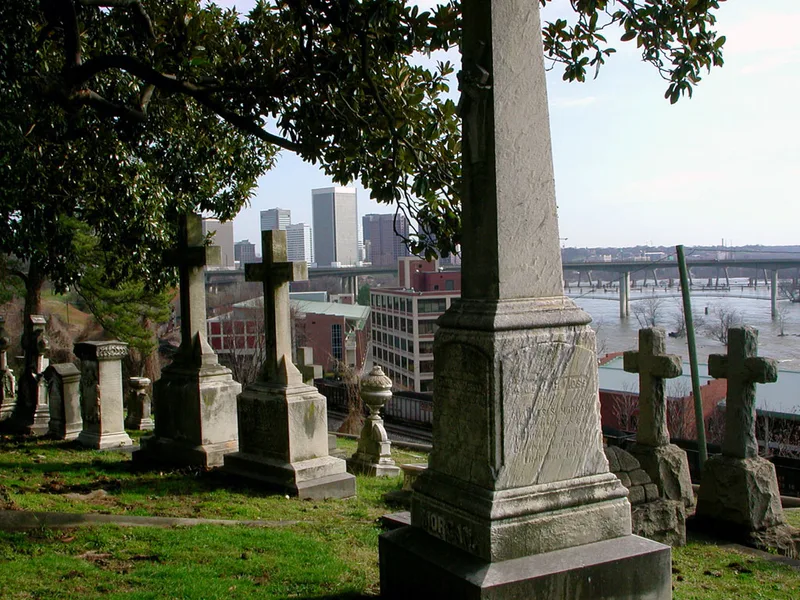
Hollywood Cemetery occupies a hilly bluff above the James River in Richmond, Virginia. Richmond business leaders first planned it in 1847 as a "rural decorated cemetery," originally called Mount Vernon Cemetery. Philadelphia architect John Notman, who also designed Laurel Hill Cemetery, laid out the roads to follow the land's contours and create views at natural turns. The grounds opened for dedication in 1849, with the first burial in 1848. Some of the original ponds, bridges and a deliberate ivy-covered stone "ruin" are gone, but the planning of drives and walks survives in the original forty-four acres. Funeral sculpture imitates classic columns, tree stumps and branch-formed crosses, and Richmond ironwork is well represented. The most striking piece is the Gothic cast iron enclosure around the tomb of President James Monroe, reinterred here in 1858. Other burials include President John Tyler, Jefferson Davis, J.E.B. Stuart, and thousands of Confederate soldiers beneath a stone pyramid.
Significance in brief: The nomination argues the cemetery is an outstanding example of Romantic, picturesque landscape design by John Notman, with roads following the natural contours of the land. It also holds notable funeral sculpture and Richmond ironwork, including the cast iron Gothic tomb of President James Monroe. Many prominent Virginians and Confederate soldiers are buried there.
Machine-generated summary. This summary was generated by a language model from the official nomination document and has not been reviewed line by line by an editor. It may contain errors. Check the source document before relying on any detail. Source: nomination document (PDF) · National Archives catalog entry. NRHP reference 69000350, listed November 12, 1969. Summary generated October 2026 (model claude-sonnet-5-5, prompt v1.0-2026-10-29, confidence medium).
Key facts
| Address | 412 S. Cherry St., Richmond (Independent City) |
|---|---|
| County | Richmond (city and county) |
| Listed | November 12, 1969 |
| Reference number | 69000350 |
| Resource type | District |
| Period of significance | 19th Century |
| Architect / builder | John Notman (landscape plan and design); William H. Pratt submitted an earlier design |
| Architectural style | Romantic / English Picturesque rural cemetery landscape; Gothic chapel |
| Areas of significance | Landscape Architecture, Art |
| Level of significance | National |
| Status (as stated in the nomination) | Listed in good condition and occupied; in use as a graveyard. |
| Acreage | 130 |
| Within district | James River and Kanawha Canal Historic District |
| Coordinates | 37.53632, -77.45815 (NPS GIS) |
What listing means for this property
This is a historic district. Buildings within its boundary are either contributing (they add to the district's significance) or non-contributing. Owners of contributing income-producing buildings can claim the 20% federal rehabilitation tax credit; homeowners should look at state credits. National Register districts impose no design review by themselves; a local historic district ordinance, if one exists, does (the difference explained).
General information, not legal or tax advice. Rules change; confirm with your State Historic Preservation Office or a qualified adviser.
Sources and further reading
- National Park Service, National Register of Historic Places database (snapshot May 2026), reference 69000350.
- Nomination form (PDF, National Archives) — catalog entry
- Wikipedia article (used for cross-checking only; text not reproduced here)
- Wikidata Q5882648
- This listing as JSON
Last updated October 2026. Found an error? See the editorial policy for how to report it.