Monroe, James, Tomb

Why it's listed
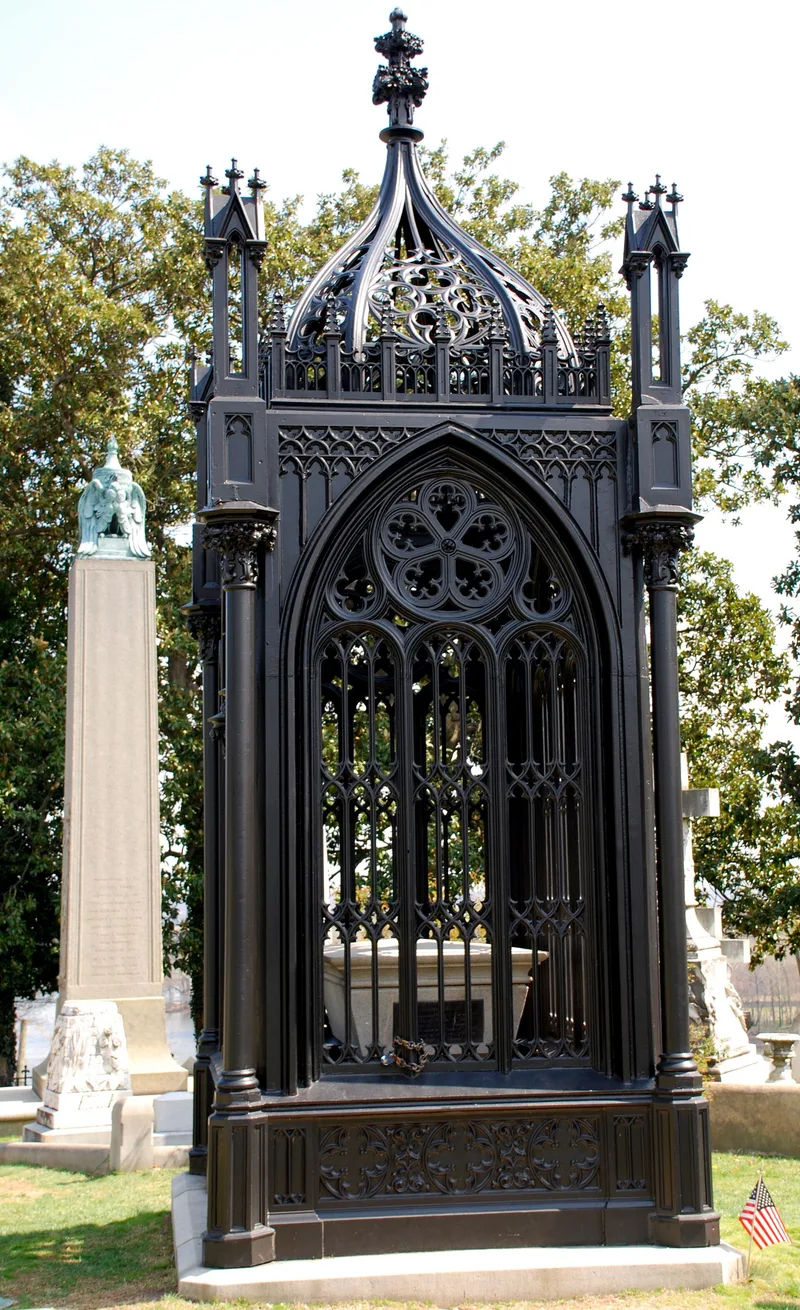
Overlooking the James River from a bluff in Hollywood Cemetery, this roughly 13-by-9-foot cast iron cage shelters the granite sarcophagus of James Monroe, fifth President of the United States. Erected in 1859 and designed by Alsatian-born architect Albert Lybrock, it was cast in Philadelphia by Wood and Perot at a cost of $1,682. Its flamboyant Gothic Revival design uses lancet-arched screens on all four sides, corner colonettes topped by small tabernacles, rose-window tracery and an open ogival canopy. Monroe died in New York in 1831 and was reburied in Virginia in 1856-1858 after the state voted funds for his return. The tomb is recognized chiefly for its material: iron allowed delicate open tracery outdoors at a scale stone could not match. Though a small-scale masterpiece of cast iron architecture, it did not influence later design as widely as larger iron works such as the Capitol dome. A low stone wall circles the tomb.
Significance in brief: The nomination argues the tomb matters for its material rather than its style or architect. The open Gothic tracery could be achieved in cast iron for an outdoor tomb in a way not possible at this scale in stone. It is called a small-scale masterpiece of cast iron architecture, though it did not have the far-reaching influence of works like the U.S. Capitol dome.
Machine-generated summary. This summary was generated by a language model from the official nomination document and has not been reviewed line by line by an editor. It may contain errors. Check the source document before relying on any detail. Source: nomination document (PDF) · National Archives catalog entry. NRHP reference 71001044, listed November 11, 1971. Summary generated October 2026 (model claude-sonnet-5-5, prompt v1.0-2026-10-29, confidence high).
Key facts
| Address | Hollywood Cemetery, 412 S. Cherry St., Richmond (Independent City) |
|---|---|
| County | Richmond (city and county) |
| Listed | November 11, 1971 |
| Reference number | 71001044 |
| Resource type | Structure |
| Period of significance | 19th Century |
| Architect / builder | Albert Lybrock (architect); cast by Wood and Perot of Philadelphia |
| Architectural style | Gothic Revival |
| Areas of significance | Politics/Government, Architecture |
| Level of significance | National |
| National Historic Landmark | Yes, designated November 11, 1971 |
| Status (as stated in the nomination) | Condition is listed as good, and the structure is unaltered and on its original site. |
| Acreage | 0.9 |
| Within district | Hollywood Cemetery |
| Coordinates | 37.53377, -77.45651 (NPS GIS) |
What listing means for this property
National Register listing is honorary: it recognises significance and does not restrict what a private owner may do without federal money or permits. It unlocks the 20% federal rehabilitation tax credit for income-producing buildings, state credits in many states, and Section 106 review when federal agencies are involved. See what listing means in practice.
General information, not legal or tax advice. Rules change; confirm with your State Historic Preservation Office or a qualified adviser.
Sources and further reading
- National Park Service, National Register of Historic Places database (snapshot May 2026), reference 71001044.
- Nomination form (PDF, National Archives) — catalog entry
- Wikipedia article (used for cross-checking only; text not reproduced here)
- Wikidata Q6139920
- This listing as JSON
Last updated October 2026. Found an error? See the editorial policy for how to report it.