St. Sophia Home of the Little Sisters of the Poor
Also known as: Little Sisters of the Poor Home for the Aged

Why it's listed
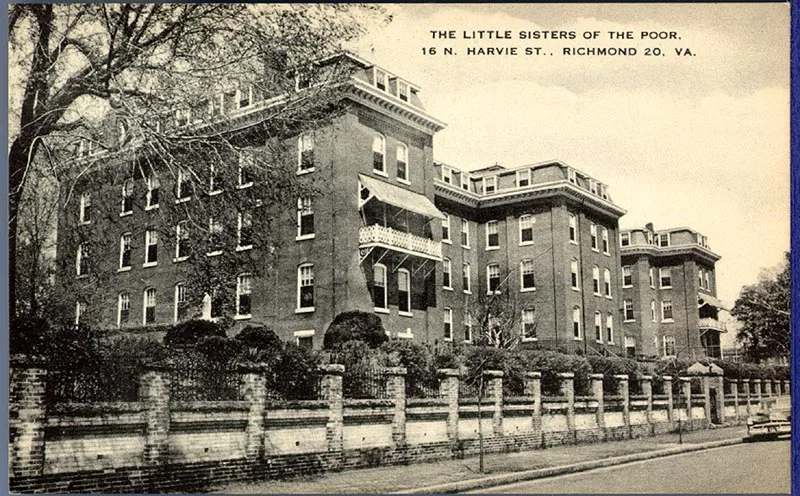
At 16 North Harvie Street in Richmond, a large brick complex grew from a brick farmhouse called Warsaw, built in 1832 for William Anderson. In 1876 Bishop James Gibbons bought Warsaw and four lots and gave them to the Little Sisters of the Poor, a Catholic order of nuns. The sisters converted the house into a charitable hospital and enlarged it in the Italianate style between 1877 and 1881. A convent wing followed in 1894, along with a mansard roof that added a fourth floor and gave the building a Second Empire character. A chapel, outbuildings, a stable and a brick retaining wall complete the grounds. Patients were admitted without regard to religion, nationality or race. The hospital was among the few major institutional buildings in Richmond in the 1870s, and the nomination calls it a rare surviving example of late Victorian institutional architecture and a significant element of the Fan District. The sisters left in 1976 after ninety-nine years of service in the neighborhood.
Significance in brief: The nomination argues the building is a rare Richmond example of late Victorian institutional architecture and an important part of the Fan District. It also encloses Warsaw, an 1832 farmhouse built for William Anderson. The Little Sisters of the Poor ran a charitable hospital there for ninety-nine years, and its Second Empire mansard roof is described as rare among Southern Reconstruction-period buildings.
Machine-generated summary. This summary was generated by a language model from the official nomination document and has not been reviewed line by line by an editor. It may contain errors. Check the source document before relying on any detail. Source: nomination document (PDF) · National Archives catalog entry. NRHP reference 80004217, listed May 7, 1980. Summary generated October 2026 (model claude-sonnet-5-5, prompt v1.0-2026-10-29, confidence high).
Key facts
| Address | 16 N. Harvie St., Richmond (Independent City) |
|---|---|
| County | Richmond (city and county) |
| Listed | May 7, 1980 |
| Reference number | 80004217 |
| Resource type | Building |
| Period of significance | 1832, 1877, 1881, 1894 |
| Architectural style | Italianate and Second Empire |
| Areas of significance | Architecture, Religion, Social History |
| Level of significance | State |
| Status (as stated in the nomination) | The Little Sisters vacated the home in 1976. The form lists it as partially unoccupied, under new ownership and awaiting conversion into apartments. |
| Acreage | 3 |
| Within district | James River and Kanawha Canal Historic District |
| Coordinates | 37.54739, -77.45852 (NPS GIS) |
What listing means for this property
National Register listing is honorary for a privately owned home: it does not by itself restrict what an owner may do with their own money, and it does not require public access. Restrictions come from local landmark or historic-district ordinances, which are separate (how they differ).
Owner-occupied houses are not eligible for the 20% federal rehabilitation tax credit, which applies to income-producing buildings, but many states offer credits for homeowners. Listing also opens the door to preservation easements and to buying a plaque. Start with what listing means for homeowners, renovating a listed house and selling one.
General information, not legal or tax advice. Rules change; confirm with your State Historic Preservation Office or a qualified adviser.
Sources and further reading
- National Park Service, National Register of Historic Places database (snapshot May 2026), reference 80004217.
- Nomination form (PDF, National Archives) — catalog entry
- Wikipedia article (used for cross-checking only; text not reproduced here)
- Wikidata Q16900617
- This listing as JSON
Last updated October 2026. Found an error? See the editorial policy for how to report it.