Norfolk Academy

Why it's listed
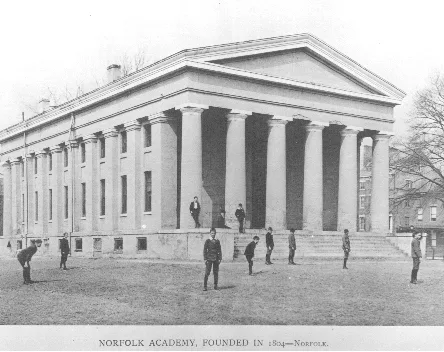
Norfolk Academy's old building at 420 Bank Street is a two-story, stuccoed temple-form structure in downtown Norfolk. Its cornerstone was laid on May 25, 1840, to designs by the noted Philadelphia architect Thomas U. Walter. Although it uses an unfluted Greek Doric order, it follows the plan of a Roman temple, rising on a podium with pilasters between the bays rather than freestanding columns. Hexastyle pedimented porticoes mark both the front and rear. The school's origins reach back to a 1728 land grant for a school; it took the name Norfolk Academy in 1787 and was incorporated in 1804. The school left the building in 1915, and it later became the city's Juvenile and Domestic Relations Court. Edgar Allan Poe is said to have given his last public lecture there in 1849. It was listed as an important monument of the Greek Revival period, valued for its design quality and its architect's reputation.
Significance in brief: The building is presented as one of the important monuments of the Greek Revival period, because of the quality of its design and the fame of its architect. It also housed Norfolk Academy, whose origins date to 1728, and is said to be the site of Edgar Allan Poe's last public lecture in 1849.
Machine-generated summary. This summary was generated by a language model from the official nomination document and has not been reviewed line by line by an editor. It may contain errors. Check the source document before relying on any detail. Source: nomination document (PDF) · National Archives catalog entry. NRHP reference 69000343, listed November 12, 1969. Summary generated October 2026 (model claude-sonnet-5-5, prompt v1.0-2026-10-29, confidence medium).
Key facts
| Address | 420 Bank St., Norfolk (Independent City) |
|---|---|
| County | Norfolk |
| Listed | November 12, 1969 |
| Reference number | 69000343 |
| Resource type | Building |
| Period of significance | 19th Century (specific date 1840) |
| Architect / builder | Thomas U. Walter of Philadelphia |
| Architectural style | Greek Revival (temple-form, Greek Doric order on a Roman temple plan) |
| Areas of significance | Architecture |
| Level of significance | National |
| Status (as stated in the nomination) | Condition listed as fair; occupied by the Juvenile Court only, with expected conversion to Norfolk Chamber of Commerce use. The school left the building in 1915. |
| Coordinates | 36.85195, -76.28487 (NPS GIS) |
What listing means for this property
For a publicly owned building or structure, listing mainly matters when federal funds, permits or licences are involved: projects then go through Section 106 review so effects on the property are considered. Listing also strengthens applications for preservation grants and, for leased income-producing uses, can enable the federal rehabilitation tax credit.
General information, not legal or tax advice. Rules change; confirm with your State Historic Preservation Office or a qualified adviser.
Sources and further reading
- National Park Service, National Register of Historic Places database (snapshot May 2026), reference 69000343.
- Nomination form (PDF, National Archives) — catalog entry
- Wikipedia article (used for cross-checking only; text not reproduced here)
- Wikidata Q7050987
- This listing as JSON
Last updated October 2026. Found an error? See the editorial policy for how to report it.