Glass, Carter, House

Why it's listed
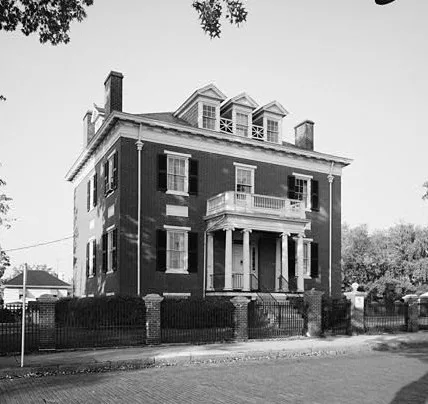
Built in 1827 by John Wills, a lawyer and architect, this red-brick house at 605 Clay Street in Lynchburg has a raised stone-foundation basement, a slate hipped roof, eight gabled dormers and an Ionic front portico. Its central-hall plan, wood mantels and original sliding doors survive. Carter Glass bought it in 1907 and lived there with his family until 1923, keeping it until he died in 1946. He installed central heating and plumbing, raised the attic roof and added the dormers. These years covered his greatest national influence. In Congress he drafted the Glass-Owen Act of 1913, which established the Federal Reserve System. He served as Secretary of the Treasury in 1919-20, and in 1933 he helped push through the Glass-Steagall Act on banking reform. A church acquired the house in 1960 and uses it as a parish house, with only minor changes to the interior and the Clay Street setting.
Significance in brief: The house was the home of Carter Glass from 1907 to 1923, the period of his greatest national significance. Glass drafted the Glass-Owen Act creating the Federal Reserve System, served as Secretary of the Treasury, and later helped shape the Glass-Steagall Act and the Banking Act of 1935. He kept ownership of the house until his death in 1946.
Machine-generated summary. This summary was generated by a language model from the official nomination document and has not been reviewed line by line by an editor. It may contain errors. Check the source document before relying on any detail. Source: nomination document (PDF) · National Archives catalog entry. NRHP reference 76002183, listed December 8, 1976. Summary generated October 2026 (model claude-sonnet-5-5, prompt v1.0-2026-10-29, confidence medium).
Key facts
| Address | 605 Clay St., Lynchburg (Independent City) |
|---|---|
| County | Lynchburg |
| Listed | December 8, 1976 |
| Reference number | 76002183 |
| Resource type | Building |
| Period of significance | 1907-1923 |
| Architect / builder | John Wills (also given as John Mills in the description) |
| Areas of significance | Commerce, Economics, Politics/Government |
| Level of significance | National |
| National Historic Landmark | Yes, designated December 8, 1976 |
| Status (as stated in the nomination) | In good condition with minor alterations; used as a parish house by the adjoining church, with a carriage house used as a church nursery. |
| Acreage | 1.5 |
| Coordinates | 37.41524, -79.14720 (NPS GIS) |
What listing means for this property
National Register listing is honorary for a privately owned home: it does not by itself restrict what an owner may do with their own money, and it does not require public access. Restrictions come from local landmark or historic-district ordinances, which are separate (how they differ).
Owner-occupied houses are not eligible for the 20% federal rehabilitation tax credit, which applies to income-producing buildings, but many states offer credits for homeowners. Listing also opens the door to preservation easements and to buying a plaque. Start with what listing means for homeowners, renovating a listed house and selling one.
General information, not legal or tax advice. Rules change; confirm with your State Historic Preservation Office or a qualified adviser.
Sources and further reading
- National Park Service, National Register of Historic Places database (snapshot May 2026), reference 76002183.
- Nomination form (PDF, National Archives) — catalog entry
- Wikipedia article (used for cross-checking only; text not reproduced here)
- Wikidata Q5047159
- This listing as JSON
Last updated October 2026. Found an error? See the editorial policy for how to report it.