Hampton National Cemetery
Also known as: VDHR File No. 114-0148

Why it's listed
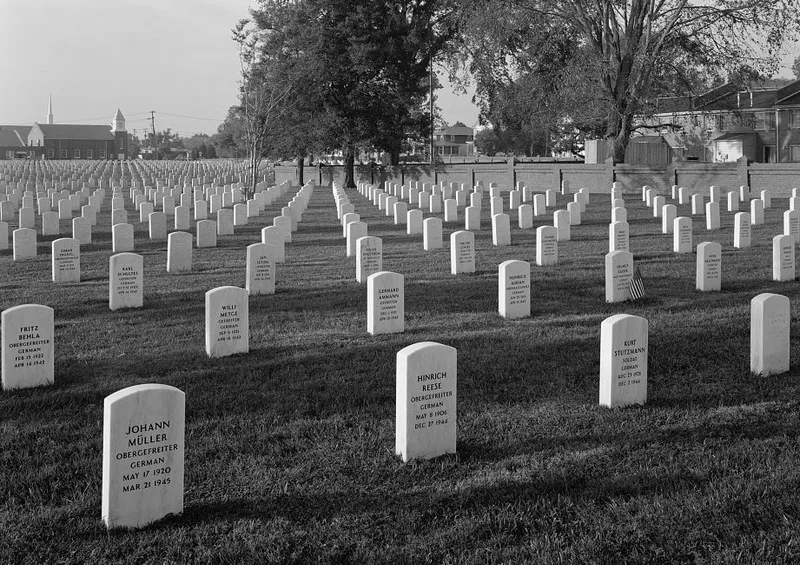
Hampton National Cemetery occupies a rectilinear site on Cemetery Road in Hampton, Virginia, roughly 2 miles from Fort Monroe. Established in 1866 on about 11.5 acres, it grew with the 1891 purchase of the separate Phoebus Section. Granite and brick walls, wrought-iron gates, a 1940 Georgian Revival brick lodge, utility buildings and a 65-foot Quincy granite obelisk, raised through efforts led by Dorothea Dix, make up the contributing features. The grounds hold more than 25,000 casketed burials, including about 638 unknown soldiers, 272 Confederate dead and eight Medal of Honor recipients. The cemetery grew from land set aside for the Hampton Military Hospital at Fort Monroe, a major Union base throughout the Civil War. That link to the war's operations in the Hampton Roads region, including Big Bethel, the Monitor and Merrimack encounter and the Hampton Roads Peace Conference, underlies its listing for its association with the Civil War.
Significance in brief: The nomination argues significance under Criterion A through the cemetery's association with the Civil War. Its land was set aside for the Hampton Military Hospital at Fort Monroe, a key Union base, and it became the burial ground for the war's dead from that region.
Machine-generated summary. This summary was generated by a language model from the official nomination document and has not been reviewed line by line by an editor. It may contain errors. Check the source document before relying on any detail. Source: nomination document (PDF) · National Archives catalog entry. NRHP reference 96000038, listed February 26, 1996. Summary generated October 2026 (model claude-sonnet-5-5, prompt v1.0-2026-10-29, confidence medium).
Key facts
| Address | Jct. of Cemetery Rd. and Marshall Ave., Hampton (Independent City) |
|---|---|
| County | Hampton |
| Listed | February 26, 1996 |
| Reference number | 96000038 |
| Resource type | Site |
| Period of significance | 1868-1940 |
| Architectural style | Late 19th and 20th Century Revivals: Georgian Revival |
| Criteria |
|
| Areas of significance | Military, Architecture |
| Level of significance | National |
| Status (as stated in the nomination) | Officially closed to new graves in 1993, though interments in occupied and reserved graves and of cremated remains continue; the lodge was renovated in 1994 for use as the administrative office. |
| Acreage | 27.1 |
| Coordinates | 37.02034, -76.33299 (NPS GIS) |
What listing means for this property
Sites (archaeological sites, battlefields, landscapes) are often listed with a restricted address to protect them from looting or disturbance. Listing is honorary for private owners; federal undertakings on or near the site go through Section 106 review, and state laws may protect burials and artefacts regardless of listing.
General information, not legal or tax advice. Rules change; confirm with your State Historic Preservation Office or a qualified adviser.
Sources and further reading
- National Park Service, National Register of Historic Places database (snapshot May 2026), reference 96000038.
- Nomination form (PDF, National Archives) — catalog entry
- Wikipedia article (used for cross-checking only; text not reproduced here)
- Wikidata Q1436015
- This listing as JSON
Last updated October 2026. Found an error? See the editorial policy for how to report it.