Victoria Boulevard Historic District
Also known as: VHLC File No. 114-112

Why it's listed
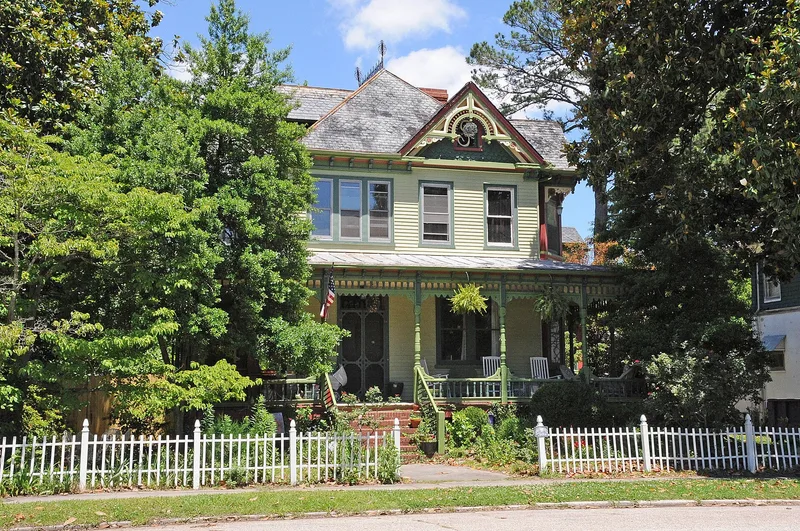
Victoria Boulevard Historic District is a streetcar suburb in Hampton, Virginia, a short distance south of the downtown business area. It contains 104 dwellings, most of them large houses built in the 1890s and the first two decades of the 1900s. Nearly all follow one of three compatible styles: Queen Anne, Colonial Revival or American Foursquare, giving the neighborhood a consistent scale and use of materials. The district spreads across Victoria Boulevard, Park Place, parts of Linden Avenue, Columbia Street, Bridge Street and neighboring streets. Frank W. Darling, whose early house at 4403 dates to about 1895, laid out the area, including the grassy square now called Park Place. Notable examples include the yellow brick Colonial Revival Reed House and a Colonial Revival house at 822 Breakwater, described as one of the best on the Peninsula. Linden Avenue was built for a somewhat lower social stratum and is dominated by Foursquare houses. Seventeen modern houses do not contribute to the district's character, and one lot is vacant.
Significance in brief: The district is a cohesive early suburb whose houses, mostly large, follow three compatible styles: Queen Anne, Colonial Revival and American Foursquare. Scale and materials are consistent across the blocks. It was laid out by Frank W. Darling, and the houses are tied to the streetcar line toward Newport News. Seventeen modern dwellings are noncontributing.
Machine-generated summary. This summary was generated by a language model from the official nomination document and has not been reviewed line by line by an editor. It may contain errors. Check the source document before relying on any detail. Source: nomination document (PDF) · National Archives catalog entry. NRHP reference 84000039, listed October 4, 1984. Summary generated October 2026 (model claude-sonnet-5-5, prompt v1.0-2026-10-29, confidence medium).
Key facts
| Address | Roughly bounded by Sunset Creek, Armisted and Linden Aves., and Bridge St., Hampton (Independent City) |
|---|---|
| County | Hampton |
| Listed | October 4, 1984 |
| Reference number | 84000039 |
| Resource type | District |
| Architect / builder | Frank W. Darling (developer/builder of several houses); other builders named in the inventory include R.H. Jackson, James Sclater, W.W. Richardson, R.F. Slaughter and Joseph B. Brittingham |
| Architectural style | Queen Anne, Colonial Revival, American Foursquare |
| Areas of significance | Community Planning and Development, Education, Architecture |
| Level of significance | State |
| Status (as stated in the nomination) | Condition is marked excellent, with the district both altered and unaltered. Most buildings are occupied private residences, and there is one vacant lot. |
| Acreage | 38 |
| Coordinates | 37.02018, -76.34559 (NPS GIS) |
What listing means for this property
This is a historic district. Buildings within its boundary are either contributing (they add to the district's significance) or non-contributing. Owners of contributing income-producing buildings can claim the 20% federal rehabilitation tax credit; homeowners should look at state credits. National Register districts impose no design review by themselves; a local historic district ordinance, if one exists, does (the difference explained).
General information, not legal or tax advice. Rules change; confirm with your State Historic Preservation Office or a qualified adviser.
Sources and further reading
- National Park Service, National Register of Historic Places database (snapshot May 2026), reference 84000039.
- Nomination form (PDF, National Archives) — catalog entry
- Wikipedia article (used for cross-checking only; text not reproduced here)
- Wikidata Q16902672
- This listing as JSON
Last updated October 2026. Found an error? See the editorial policy for how to report it.