Mill House
Also known as: Chinn's Mill; Hatcher's Mill

Why it's listed
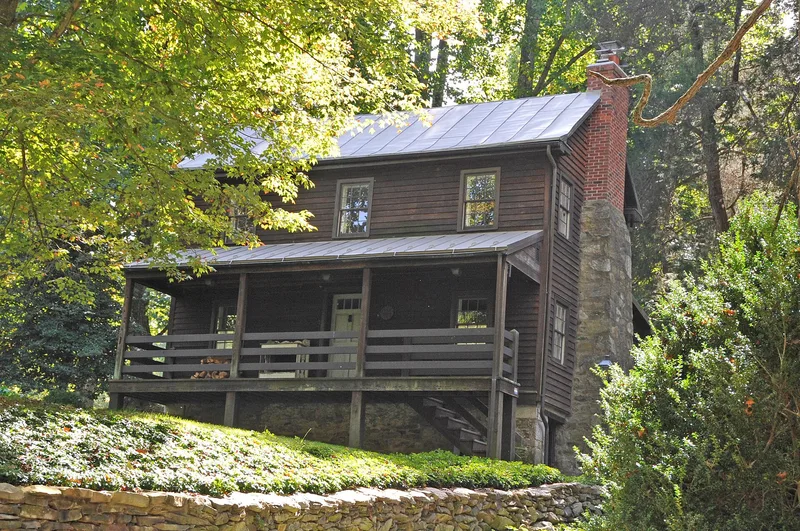
Set on a gently sloping hillside above Cromwell's Run near Middleburg, this group of random-rubble stone buildings began as a working grist mill complex. A mill was authorized in 1768 for Charles Chinn, and the property later passed to Leven Powell, the founder of Middleburg, and then to the Hatcher family, whose name stayed with the mill. Surviving buildings include the mill, miller's house, cooper's house and shop, the mill owner's house and a likely dairy or smokehouse. Late 19th-century roller mill machinery remains inside the mill. In 1924 Jay Phipps, son of a steel magnate, bought the property as a hunting retreat. Until 1929 he enlarged the main house, converted outbuildings to guest quarters, and added a stable, a swimming pool and new landscaping and roads. The complex is valued because it clearly shows both its milling origins and its later life as a hunt-country estate.
Significance in brief: The complex is argued to be an unusually complete survival of a late 18th- to early 19th-century grist mill operation. It also represents a 20th-century hunt-country estate. It is tied to Leven Powell, founder of Middleburg, and to John S. (Jay) Phipps, who converted the mill property into an equestrian estate from 1924 to 1929.
Machine-generated summary. This summary was generated by a language model from the official nomination document and has not been reviewed line by line by an editor. It may contain errors. Check the source document before relying on any detail. Source: nomination document (PDF) · National Archives catalog entry. NRHP reference 84003527, listed January 12, 1984. Summary generated October 2026 (model claude-sonnet-5-5, prompt v1.0-2026-10-29, confidence medium).
Key facts
| Address | US 50, Middleburg |
|---|---|
| County | Fauquier County |
| Listed | January 12, 1984 |
| Reference number | 84003527 |
| Resource type | Building |
| Architect / builder | unknown |
| Architectural style | Vernacular |
| Areas of significance | Industry, Entertainment/Recreation, Architecture |
| Level of significance | State |
| Status (as stated in the nomination) | Occupied as a private residence; the grounds are well maintained, but the mill is in poorer condition and used mainly for storage. |
| Acreage | 47.7 |
| Coordinates | 38.97030, -77.79203 (NPS GIS) |
What listing means for this property
National Register listing is honorary for a privately owned home: it does not by itself restrict what an owner may do with their own money, and it does not require public access. Restrictions come from local landmark or historic-district ordinances, which are separate (how they differ).
Owner-occupied houses are not eligible for the 20% federal rehabilitation tax credit, which applies to income-producing buildings, but many states offer credits for homeowners. Listing also opens the door to preservation easements and to buying a plaque. Start with what listing means for homeowners, renovating a listed house and selling one.
General information, not legal or tax advice. Rules change; confirm with your State Historic Preservation Office or a qualified adviser.
Sources and further reading
- National Park Service, National Register of Historic Places database (snapshot May 2026), reference 84003527.
- Nomination form (PDF, National Archives) — catalog entry
- Wikipedia article (used for cross-checking only; text not reproduced here)
- Wikidata Q14712849
- This listing as JSON
Last updated October 2026. Found an error? See the editorial policy for how to report it.