Carter Hall

Why it's listed
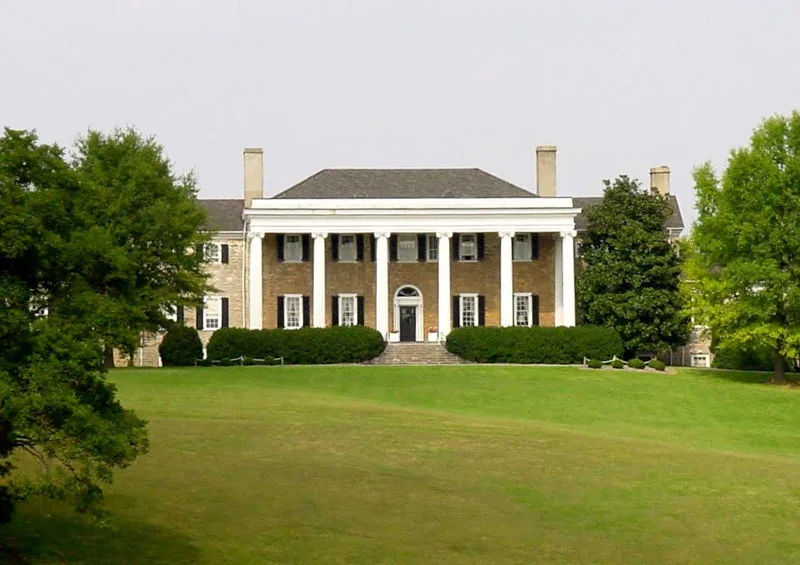
Carter Hall is a large plantation house of native limestone rubble near Millwood in Clarke County, Virginia. Built between 1792 and 1800 for Nathaniel Burwell, a Tidewater planter drawn to the fertile Shenandoah Valley, it has a five-bay center block flanked by pedimented wings and a deep hexastyle Ionic portico added after 1814 by his son George H. Burwell. The portico is traditionally credited to Dr. William Thornton. Nathaniel Burwell helped found Millwood and the Burwell-Morgan Mill with Daniel Morgan. Edmund Randolph, a former Virginia governor, died at the house in 1813. General Stonewall Jackson made his headquarters on the grounds in 1862. In 1930 architect H. T. Lindeberg remodeled the house, removing stucco and redesigning the interior, including a flying spiral stair. A terraced garden was laid out in 1948. Dependencies, outbuildings and an original gristmill remain on the grounds.
Significance in brief: The nomination argues that the architecture, grounds and historical associations make Carter Hall typical of the popular image of a Virginia plantation. It was the seat of Nathaniel Burwell, who helped found Millwood, and later of George H. Burwell. Edmund Randolph died there, and Stonewall Jackson used it as headquarters in 1862. The 1930 remodeling by H. T. Lindeberg and the terraced garden add to its architectural and landscape interest.
Machine-generated summary. This summary was generated by a language model from the official nomination document and has not been reviewed line by line by an editor. It may contain errors. Check the source document before relying on any detail. Source: nomination document (PDF) · National Archives catalog entry. NRHP reference 73002003, listed July 24, 1973. Summary generated October 2026 (model claude-sonnet-5-5, prompt v1.0-2026-10-29, confidence high).
Key facts
| Address | NE of Millwood off VA 255, Millwood |
|---|---|
| County | Clarke County |
| Listed | July 24, 1973 |
| Reference number | 73002003 |
| Resource type | Building |
| Architect / builder | H. T. Lindeberg (1930 remodeling); portico by tradition designed by Dr. William Thornton; built for Nathaniel Burwell; garden by Wade Muldoon (1948) |
| Architectural style | Late Georgian |
| Areas of significance | Landscape Architecture, Agriculture, Commerce, Military, Architecture |
| Level of significance | State |
| Status (as stated in the nomination) | Excellent condition, altered, and used as a private residence; the east dependency serves as a guest house and the west dependency as a caretaker's house. |
| Acreage | 90 |
| Within district | Greenway Historic District |
| Coordinates | 39.07094, -78.03115 (NPS GIS) |
What listing means for this property
National Register listing is honorary for a privately owned home: it does not by itself restrict what an owner may do with their own money, and it does not require public access. Restrictions come from local landmark or historic-district ordinances, which are separate (how they differ).
Owner-occupied houses are not eligible for the 20% federal rehabilitation tax credit, which applies to income-producing buildings, but many states offer credits for homeowners. Listing also opens the door to preservation easements and to buying a plaque. Start with what listing means for homeowners, renovating a listed house and selling one.
General information, not legal or tax advice. Rules change; confirm with your State Historic Preservation Office or a qualified adviser.
Sources and further reading
- National Park Service, National Register of Historic Places database (snapshot May 2026), reference 73002003.
- Nomination form (PDF, National Archives) — catalog entry
- Wikipedia article (used for cross-checking only; text not reproduced here)
- Wikidata Q5047164
- This listing as JSON
Last updated October 2026. Found an error? See the editorial policy for how to report it.