Greenway Historic District

Why it's listed
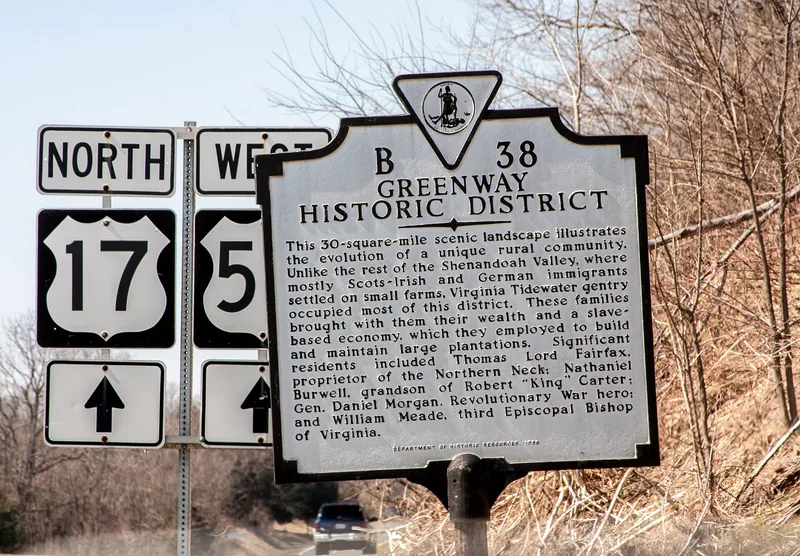
Covering about thirty square miles of southwestern Clarke County in Virginia's Lower Shenandoah Valley, this rural district is made up of rolling limestone-soil farmland, woods, streams and crossroads, with the Blue Ridge as a backdrop. Roughly 69 percent of the land is open pasture or cropland. Most of the land descends from a 1730 grant from Lord Fairfax to Robert "King" Carter, whose Tidewater heirs later moved here and built large estates, bringing plantation land-use patterns with them. The district counts hundreds of resources, mainly farm and estate houses with outbuildings, plus mills, churches, schools, corncribs and cemeteries. Notable places include Greenway Court, Fairfax's former land office complex, and Saratoga, General Daniel Morgan's limestone house begun in 1779. Carter Hall, begun in 1792, is described as the best example of a Tidewater plantation transplanted to the Valley. The district was recognized for its largely intact agricultural landscape and its range of architecture.
Machine-generated summary. This summary was generated by a language model from the official nomination document and has not been reviewed line by line by an editor. It may contain errors. Check the source document before relying on any detail. Source: nomination document (PDF) · catalog entry. Generated October 2026 (model claude-sonnet-5-5, prompt v1.0-2026-10-29).
| Styles | Georgian, Federal, Early Classical Revival, Greek Revival, Gothic Revival, Queen Anne, Colonial Revival, Bungalow/Craftsman, Ranch, I-house, Hall-parlor, Foursquare, Folk Victorian, Vernacular |
|---|---|
| Areas of significance | Industry, Agriculture, Transportation, Education, Exploration/Settlement, Architecture |
| Acreage | 19.1 |
| Boundary source | NPS cultural-resource GIS polygon |
| Full listing page | Greenway Historic District (property record) |
What listing means for this property
This is a historic district. Buildings within its boundary are either contributing (they add to the district's significance) or non-contributing. Owners of contributing income-producing buildings can claim the 20% federal rehabilitation tax credit; homeowners should look at state credits. National Register districts impose no design review by themselves; a local historic district ordinance, if one exists, does (the difference explained).
General information, not legal or tax advice. Rules change; confirm with your State Historic Preservation Office or a qualified adviser.