Wahrenberger House

Why it's listed
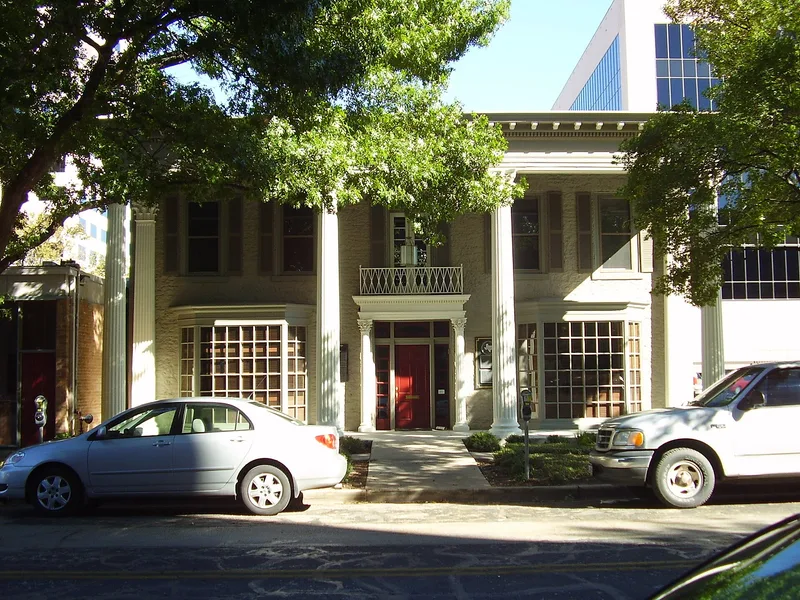
Two blocks from the Texas State Capitol in Austin, this limestone house at 208 West Fourteenth Street was built by Friedrich Huster in 1867-68 as a two-story, central-hall residence with a separate kitchen. Over the decades it was enlarged and remodeled, gaining a double gallery in 1887 and a classical portico in 1916, which gave it its Classical Revival look. It served many purposes: a German-American Ladies College from 1874, the Texas German and English Academy in the 1880s, and a family home for the Wahrenberger family until the 1940s. Boarders included future governor Pat Neff and future U.S. House Speaker Sam Rayburn. After 1946 it housed an interior decorating firm. Stucco covers most of the stone walls, though the north wall remains original. Few nineteenth-century buildings survive in the capitol area, and when the property was nominated it was vacant, with renovation underway.
Significance in brief: It is one of the few remaining nineteenth-century buildings in the capitol complex area and typifies the vernacular limestone, central-hall houses of mid-19th century Austin. It also served as an early Protestant boys' school, a ladies' college and a boardinghouse for state officials, including Pat Neff and Sam Rayburn.
Machine-generated summary. This summary was generated by a language model from the official nomination document and has not been reviewed line by line by an editor. It may contain errors. Check the source document before relying on any detail. Source: nomination document (PDF) · National Archives catalog entry. NRHP reference 78002995, listed February 23, 1978. Summary generated October 2026 (model claude-sonnet-5-5, prompt v1.0-2026-10-29, confidence medium).
Key facts
| Address | 208 W. 14th St., Austin |
|---|---|
| County | Travis County |
| Listed | February 23, 1978 |
| Reference number | 78002995 |
| Resource type | Building |
| Architect / builder | Friedrich (Freidrich) Huster, builder |
| Architectural style | Classical Revival (present appearance); vernacular limestone central-hall house |
| Areas of significance | Education, Architecture |
| Level of significance | Local |
| Status (as stated in the nomination) | Listed as vacant at the time of nomination; renovation was underway after acquisition by an Austin firm in 1977. Condition marked good and altered. |
| Acreage | 0.9 |
| Coordinates | 30.27681, -97.74203 (NPS GIS) |
What listing means for this property
National Register listing is honorary for a privately owned home: it does not by itself restrict what an owner may do with their own money, and it does not require public access. Restrictions come from local landmark or historic-district ordinances, which are separate (how they differ).
Owner-occupied houses are not eligible for the 20% federal rehabilitation tax credit, which applies to income-producing buildings, but many states offer credits for homeowners. Listing also opens the door to preservation easements and to buying a plaque. Start with what listing means for homeowners, renovating a listed house and selling one.
Noted as vacant in the nomination. Nomination documents can be decades old; current status may differ. If you are considering buying an empty listed property, read the due-diligence checklist.
General information, not legal or tax advice. Rules change; confirm with your State Historic Preservation Office or a qualified adviser.
Sources and further reading
- National Park Service, National Register of Historic Places database (snapshot May 2026), reference 78002995.
- Nomination form (PDF, National Archives) — catalog entry
- Wikipedia article (used for cross-checking only; text not reproduced here)
- Wikidata Q7959844
- This listing as JSON
Last updated October 2026. Found an error? See the editorial policy for how to report it.