Sixth Street Historic District
Also known as: See Also:Driscill Hotel; U.S. Post Office and Federal Buildin

Why it's listed
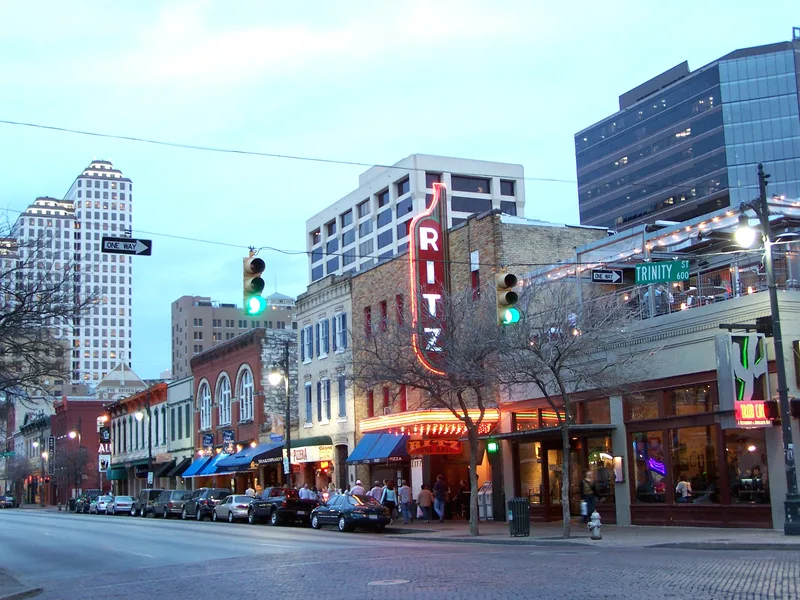
Austin's Sixth Street district covers about nine blocks of downtown, mainly East 6th Street from Interstate 35 to Congress Avenue, plus a western stretch with two former federal buildings. Most buildings are two- or three-story masonry stores from the 1870s to 1890s. Local cream-colored limestone and light brick give the street a consistent appearance, with segmental arched windows, metal or brick cornices and some cast-iron detail. Larger landmarks include the 1886 Richardsonian Romanesque Driskill Hotel, the 1878 Renaissance Revival Federal Building, the 1912 Classical Revival Post Office, and the Scarbrough and Littlefield buildings, early tall structures at Congress Avenue. From the 1890s, businesses owned by Lebanese, Jewish, German, Chinese, Black and Mexican American families added to the street's variety. Commercial decline followed the 1940s, but a local architect's 1968 townhouse restoration began a wave of reuse as restaurants, shops and homes. Some intrusions remain, including a bank tower, a drive-in bank and a parking lot.
Significance in brief: The district holds a large, cohesive concentration of two- and three-story Victorian commercial buildings in local limestone and light brick. It also includes landmark buildings such as the Driskill Hotel, the 1878 Federal Building, the 1912 Post Office and Austin's first skyscrapers. Its history reflects Austin's commercial growth, the multi-ethnic character of its businesses, and a revival through restoration begun in the late 1960s and early 1970s.
Machine-generated summary. This summary was generated by a language model from the official nomination document and has not been reviewed line by line by an editor. It may contain errors. Check the source document before relying on any detail. Source: nomination document (PDF) · National Archives catalog entry. NRHP reference 75002132, listed December 30, 1975. Summary generated October 2026 (model claude-sonnet-5-5, prompt v1.0-2026-10-29, confidence medium).
Key facts
| Address | Roughly bounded by 5th, 7th, Lavaca Sts. and I-35, Austin |
|---|---|
| County | Travis County |
| Listed | December 30, 1975 |
| Reference number | 75002132 |
| Resource type | District |
| Architect / builder | James G. Hill (Supervising Architect) and contractor Abner Cook for the 1878 Federal Building; John Knox Taylor (Supervising Architect's office) for the 1912 Post Office |
| Architectural style | Victorian commercial; Richardsonian Romanesque, Queen Anne, Renaissance Revival and Classical Revival examples |
| Areas of significance | Commerce, Black, European, Hispanic, Architecture |
| Level of significance | Local |
| Status (as stated in the nomination) | Many buildings are in use as restaurants, shops, offices and housing. Several have been restored since 1968, others have altered storefronts, and one block is a parking lot. |
| Acreage | 28 |
| Coordinates | 30.26741, -97.73997 (NPS GIS) |
What listing means for this property
This is a historic district. Buildings within its boundary are either contributing (they add to the district's significance) or non-contributing. Owners of contributing income-producing buildings can claim the 20% federal rehabilitation tax credit; homeowners should look at state credits. National Register districts impose no design review by themselves; a local historic district ordinance, if one exists, does (the difference explained).
General information, not legal or tax advice. Rules change; confirm with your State Historic Preservation Office or a qualified adviser.
Sources and further reading
- National Park Service, National Register of Historic Places database (snapshot May 2026), reference 75002132.
- Nomination form (PDF, National Archives) — catalog entry
- Wikidata Q109774598
- This listing as JSON
Last updated October 2026. Found an error? See the editorial policy for how to report it.