Millett Opera House

Why it's listed
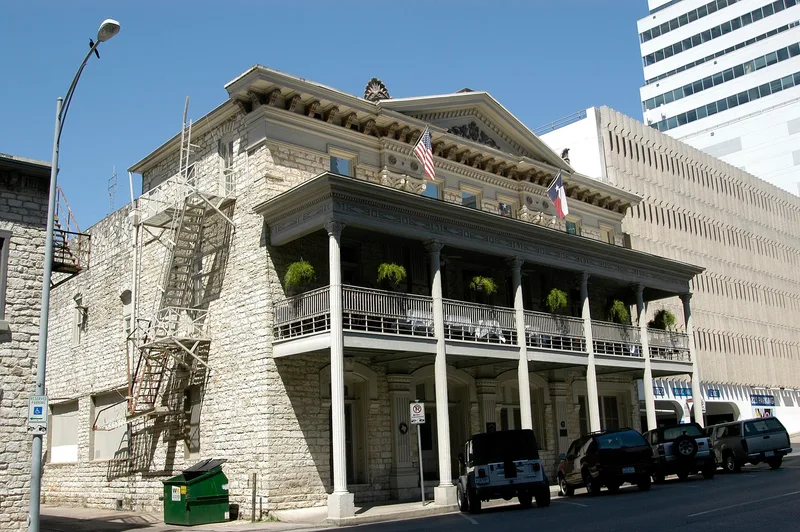
Completed in 1878 at 110 East 9th Street, the Millett Opera House gave Austin its first true theatre. Lumber and construction businessman Charles Millett financed the two-story limestone building, which architect F.E. Ruffini designed. With 56-foot trusses beneath a gambrel roof, it had the largest span of any building in Texas, and its 800 seats could hold a notable share of the city's population. For about sixteen years it was the focus of Austin's cultural life, hosting touring stars such as Edwin Booth, lectures by William Jennings Bryan, concerts, conventions, dances, boxing and roller skating. It also served briefly as a temporary meeting place for the Texas legislature. After a larger opera house opened, the building was converted to a dance hall, gained a third story and a full second floor, and was remodeled by the Knights of Columbus in 1911. It has been used for business since 1929, and the original pediment and anthemia remain.
Significance in brief: For about sixteen years it was Austin's center of cultural and social life, hosting touring theatrical stars, lectures, concerts, conventions and even skating and boxing. It was the state's second largest theatre, and its 56-foot trusses gave it the largest span of any building in Texas. It also briefly served as a meeting place for the Texas legislature while the new Capitol was built.
Machine-generated summary. This summary was generated by a language model from the official nomination document and has not been reviewed line by line by an editor. It may contain errors. Check the source document before relying on any detail. Source: nomination document (PDF) · National Archives catalog entry. NRHP reference 78002991, listed March 21, 1978. Summary generated October 2026 (model claude-sonnet-5-5, prompt v1.0-2026-10-29, confidence high).
Key facts
| Address | 110 E. 9th St., Austin |
|---|---|
| County | Travis County |
| Listed | March 21, 1978 |
| Reference number | 78002991 |
| Resource type | Building |
| Period of significance | 1800-1899 |
| Architect / builder | F.E. Ruffini (architect); Charles Millett (financier/builder) |
| Areas of significance | Architecture, Performing Arts |
| Level of significance | Local |
| Status (as stated in the nomination) | Described as occupied, in good condition and used as a business office, with exterior changes from the 1896 and 1911 remodelings; the nomination lists an office supply company as tenant since 1956. |
| Acreage | 0.9 |
| Coordinates | 30.27080, -97.74065 (NPS GIS) |
What listing means for this property
National Register listing is honorary for a privately owned home: it does not by itself restrict what an owner may do with their own money, and it does not require public access. Restrictions come from local landmark or historic-district ordinances, which are separate (how they differ).
Owner-occupied houses are not eligible for the 20% federal rehabilitation tax credit, which applies to income-producing buildings, but many states offer credits for homeowners. Listing also opens the door to preservation easements and to buying a plaque. Start with what listing means for homeowners, renovating a listed house and selling one.
General information, not legal or tax advice. Rules change; confirm with your State Historic Preservation Office or a qualified adviser.
Sources and further reading
- National Park Service, National Register of Historic Places database (snapshot May 2026), reference 78002991.
- Nomination form (PDF, National Archives) — catalog entry
- Wikipedia article (used for cross-checking only; text not reproduced here)
- Wikidata Q6859447
- This listing as JSON
Last updated October 2026. Found an error? See the editorial policy for how to report it.