Presidio Nuestra Senora de Loreto de la Bahia

Why it's listed
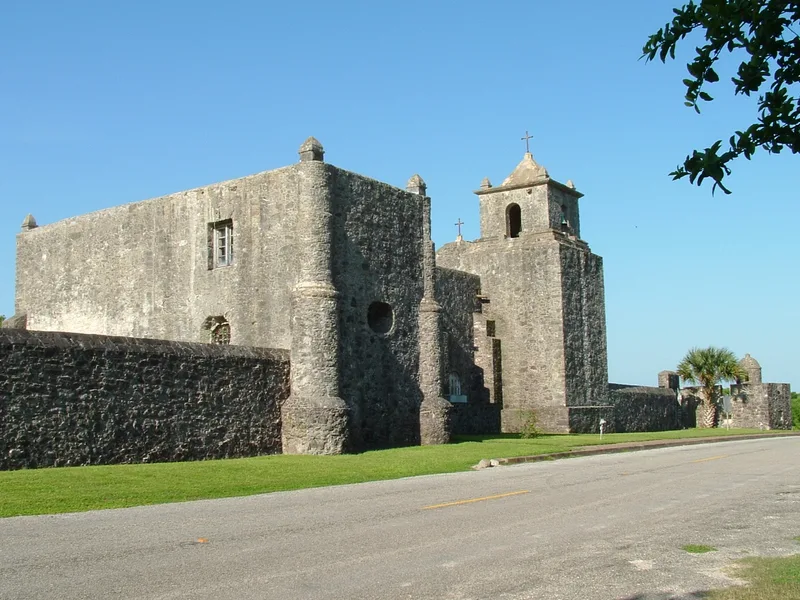
Presidio Nuestra Senora de Loreto de La Bahia is a Spanish colonial fort on a hill above the San Antonio River near Goliad, Texas. First built in 1749 with wooden buildings and grass huts inside a palisade, it was gradually rebuilt in white limestone from the early 1760s until about 1795. The one-story quadrangle has four rounded corner bastions, three gates, and rooms for officers, troops, storehouses, workshops and an arsenal. A chapel built between 1775 and 1790 stands near the northwest corner, with thick stone walls, a square bell tower and a groin-vaulted interior. The post defended the missions of southern Texas and was a principal military post under Spanish and Mexican rule. It saw several battles during the Mexican revolution against Spain and later the Texas Revolution, including the 1836 killing of more than 400 of Fannin's men. After abandonment and decay, restoration ran from 1963 to 1967. Today it operates as a museum, and the chapel is an active church.
Significance in brief: The nomination calls it probably the finest example of a Spanish presidio in the United States. It defended the missions of southern Texas and served as the principal military post under Spanish and Mexican rule. It was also the scene of the Goliad massacre of Fannin's men in March 1836 during the Texas Revolution.
Machine-generated summary. This summary was generated by a language model from the official nomination document and has not been reviewed line by line by an editor. It may contain errors. Check the source document before relying on any detail. Source: nomination document (PDF) · National Archives catalog entry. NRHP reference 67000024, listed December 24, 1967. Summary generated October 2026 (model claude-sonnet-5-5, prompt v1.0-2026-10-29, confidence high).
Key facts
| Address | 1 mi. S of Goliad State Park on U.S. 183, Goliad |
|---|---|
| County | Goliad County |
| Listed | December 24, 1967 |
| Reference number | 67000024 |
| Resource type | Building |
| Period of significance | 1749, 1836 |
| Areas of significance | Military, Exploration/Settlement |
| Level of significance | National |
| National Historic Landmark | Yes, designated December 24, 1967 |
| Status (as stated in the nomination) | Restored 1963-67 to its 1836 appearance; the grounds serve as a museum and the chapel is an active church. |
| Acreage | 45 |
| Within district | Goliad State Park Historic District |
| Coordinates | 28.64687, -97.38182 (NPS GIS) |
What listing means for this property
National Register listing is honorary: it recognises significance and does not restrict what a private owner may do without federal money or permits. It unlocks the 20% federal rehabilitation tax credit for income-producing buildings, state credits in many states, and Section 106 review when federal agencies are involved. See what listing means in practice.
General information, not legal or tax advice. Rules change; confirm with your State Historic Preservation Office or a qualified adviser.
Sources and further reading
- National Park Service, National Register of Historic Places database (snapshot May 2026), reference 67000024.
- Nomination form (PDF, National Archives) — catalog entry
- Wikipedia article (used for cross-checking only; text not reproduced here)
- Wikidata Q7241532
- This listing as JSON
Last updated October 2026. Found an error? See the editorial policy for how to report it.