Peck, Capt. Barton, House
Also known as: Peck House

Why it's listed
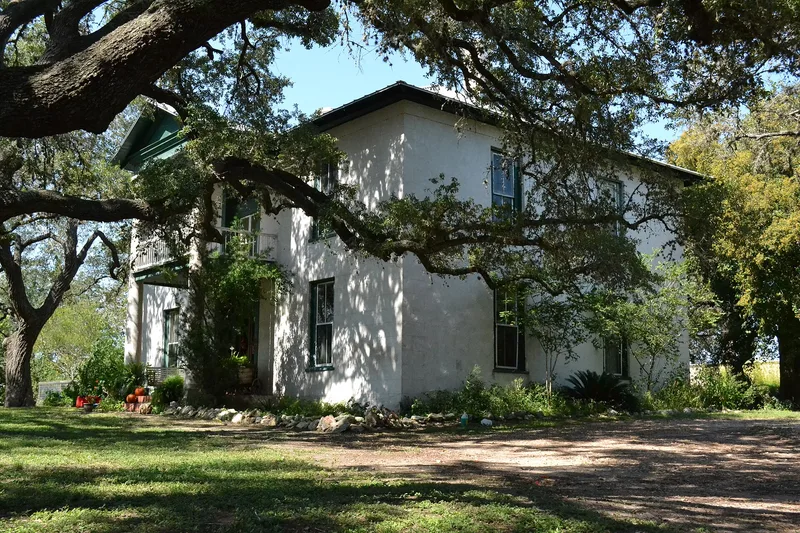
Perched on a hilltop facing the town of Goliad, this two-story house of limestone covered with stucco was built between 1842 and 1852 by Captain Barton Peck, a farmer, ranger and stockman. It measures 24 by 18 feet and has a central hall plan with four rooms per floor. Two stone Doric columns support a pedimented two-story portico, and quoins are etched into the stucco. Alterations include replacement of the original 6/6 windows with 2/2 windows, a tin roof from the 1940s, and removal in the late 1950s of a deteriorated dining room wing and an older two-room house. A rubble stone kitchen remains to the northwest. The house is considered one of the oldest in Goliad and an early Texas example of Greek Revival design. It stayed with the Peck family, including daughter Sue and her husband, Judge John Gus Patton, until 1961, when it became vacant with most furnishings intact. Restoration was planned.
Significance in brief: The nomination calls it a fine example of early Greek Revival architecture in Texas and one of the oldest remaining homes in Goliad, one of the five oldest municipalities in Texas. Its central hall plan, symmetrical facade and pedimented portico survive. It is also tied to the Peck family, prominent in the community's history and development.
Machine-generated summary. This summary was generated by a language model from the official nomination document and has not been reviewed line by line by an editor. It may contain errors. Check the source document before relying on any detail. Source: nomination document (PDF) · National Archives catalog entry. NRHP reference 79002947, listed February 23, 1979. Summary generated October 2026 (model claude-sonnet-5-5, prompt v1.0-2026-10-29, confidence high).
Key facts
| Address | W of Goliad at Hill and Post Oak St., Goliad |
|---|---|
| County | Goliad County |
| Listed | February 23, 1979 |
| Reference number | 79002947 |
| Resource type | Building |
| Period of significance | 1842-52 |
| Architect / builder | Barton Peck |
| Architectural style | Greek Revival |
| Areas of significance | Architecture |
| Level of significance | Local |
| Status (as stated in the nomination) | Unoccupied since 1961, retaining most of its original furnishings; the owner planned to restore it and return it to residential use. |
| Acreage | 5 |
| Coordinates | 28.66660, -97.40157 (NPS GIS) |
What listing means for this property
National Register listing is honorary for a privately owned home: it does not by itself restrict what an owner may do with their own money, and it does not require public access. Restrictions come from local landmark or historic-district ordinances, which are separate (how they differ).
Owner-occupied houses are not eligible for the 20% federal rehabilitation tax credit, which applies to income-producing buildings, but many states offer credits for homeowners. Listing also opens the door to preservation easements and to buying a plaque. Start with what listing means for homeowners, renovating a listed house and selling one.
Noted as vacant in the nomination. Nomination documents can be decades old; current status may differ. If you are considering buying an empty listed property, read the due-diligence checklist.
General information, not legal or tax advice. Rules change; confirm with your State Historic Preservation Office or a qualified adviser.
Sources and further reading
- National Park Service, National Register of Historic Places database (snapshot May 2026), reference 79002947.
- Nomination form (PDF, National Archives) — catalog entry
- Wikidata Q110002074
- This listing as JSON
Last updated October 2026. Found an error? See the editorial policy for how to report it.