Goliad State Park Historic District
Also known as: Goliad State Historical Park; Memorial Aditorium

Why it's listed
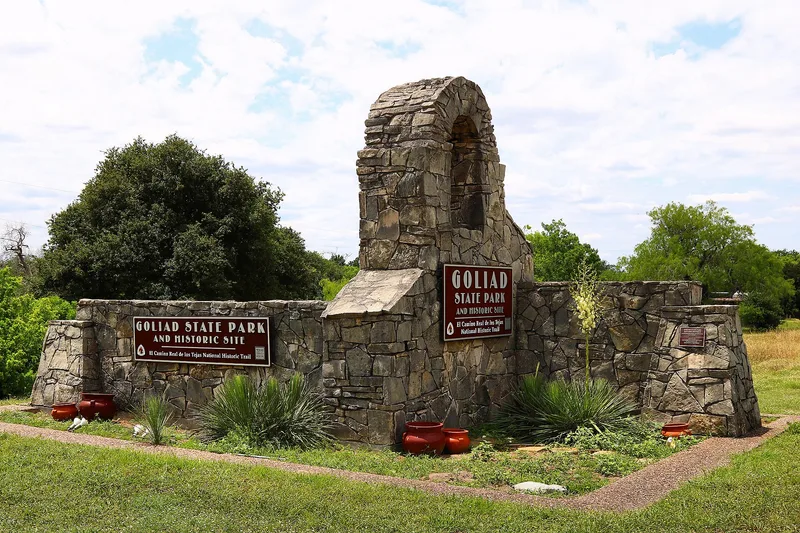
Goliad State Park Historic District occupies prairie and riverside woodland along a bend of the San Antonio River southeast of Goliad, Texas. Developed mainly in the 1930s and 1940s with New Deal funds and Civilian Conservation Corps labor, it commemorates the region's Spanish and Texas Revolution history. Its 20 contributing resources include the reconstructed Mission Espiritu Santo, a stone custodian's residence and compound with Spanish Colonial-inspired details, stretches of US Highway 183 with limestone pylons and walls, and the 1939 granite monument marking the burial of Colonel James Fannin's men. The concrete Memorial Auditorium, completed in 1937 as a Texas Centennial project and designed by Raiford Stripling and Samuel Vosper, blends Mission Style and Beaux-Arts references in an Art Moderne form, with sculpted panels and a stadium. Fourteen newer utilitarian structures do not contribute. The district is nominated as significant at the state level.
Significance in brief: The nomination presents the park as a New Deal-era commemorative landscape built with state and federal funds, including Civilian Conservation Corps labor, to memorialize Goliad's role in Texas history. It includes reconstruction of Mission Espiritu Santo, the 1937 Texas Centennial auditorium, and the 1939 Fannin monument. It is considered significant statewide, with 20 contributing resources retaining high integrity.
Machine-generated summary. This summary was generated by a language model from the official nomination document and has not been reviewed line by line by an editor. It may contain errors. Check the source document before relying on any detail. Source: nomination document (PDF) · National Archives catalog entry. NRHP reference 01000258, listed March 12, 2001. Summary generated October 2026 (model claude-sonnet-5-5, prompt v1.0-2026-10-29, confidence medium).
Key facts
| Address | US 183 at San Antonio River, Goliad |
|---|---|
| County | Goliad County |
| Listed | March 12, 2001 |
| Reference number | 01000258 |
| Resource type | District |
| Architect / builder | Raiford Stripling and Samuel Vosper (architects, Memorial Auditorium); Willard Simpson (consulting engineer); H. J. Von Rosenberg (general contractor); H. B. Zachry (contractor, J. A. White Bridge) |
| Architectural style | Spanish Colonial (reconstruction); Art Moderne; NPS Rustic |
| Areas of significance | Architecture, Entertainment/Recreation |
| Level of significance | State |
| Status (as stated in the nomination) | Historic functions continue: auditorium, museum, outdoor recreation and cemetery within a state park. Some original acres, including the auditorium, reverted to city and county ownership in 1971. The original 1934 J. A. White Bridge was demolished in 1999 and replaced in 2000. |
| Acreage | 250 |
| Coordinates | 28.65503, -97.38481 (NPS GIS) |
What listing means for this property
This is a historic district. Buildings within its boundary are either contributing (they add to the district's significance) or non-contributing. Owners of contributing income-producing buildings can claim the 20% federal rehabilitation tax credit; homeowners should look at state credits. National Register districts impose no design review by themselves; a local historic district ordinance, if one exists, does (the difference explained).
General information, not legal or tax advice. Rules change; confirm with your State Historic Preservation Office or a qualified adviser.
Sources and further reading
- National Park Service, National Register of Historic Places database (snapshot May 2026), reference 01000258.
- Nomination form (PDF, National Archives) — catalog entry
- Wikidata Q98099258
- This listing as JSON
Last updated October 2026. Found an error? See the editorial policy for how to report it.