San Pedro Springs Park

Why it's listed
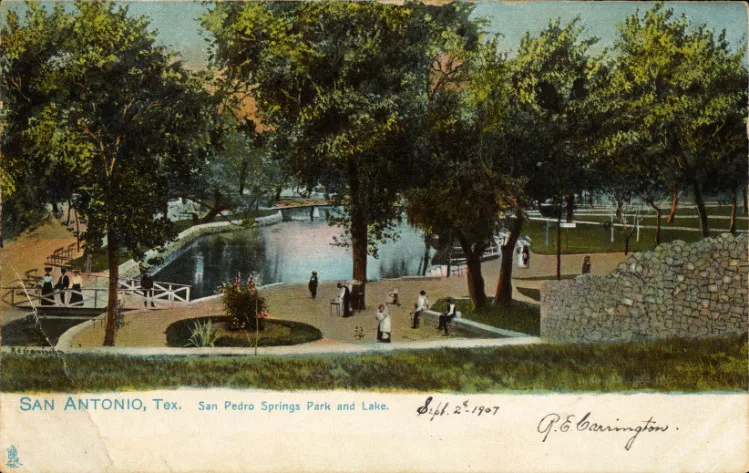
San Pedro Springs Park is a 40-acre public park in San Antonio centered on a natural spring that emerges from a limestone fissure and flows south toward the San Antonio River. Native people lived here long before Spanish explorers arrived, and in 1718 a mission and fort were established at the springs. In 1729 the Spanish crown dedicated the land as public ground, and it has served that purpose ever since. Canary Islander settlers dug stone-lined irrigation canals here, and traces remain. In the 1860s landscape artist J. J. Duerler developed the grounds into a Victorian garden with grottos, ponds, bridges and a gazebo. Later additions include a zoo, a swimming pool, a library built in 1928, a theater built in 1927, tennis courts and softball fields. The nomination describes it as probably the second oldest major municipal park in the country and notes its potential archeological value for both prehistoric and later periods.
Significance in brief: The nomination argues that the park has been inhabited since prehistoric times and has served as a public space since 1729, making it probably the second oldest major municipal park in the United States. It was the site of an Indian village, a Spanish fort and mission, military camps, a racetrack, an amusement park, a zoo and fairgrounds. It also holds a Victorian picturesque landscape designed under J. J. Duerler and has potential archeological value.
Machine-generated summary. This summary was generated by a language model from the official nomination document and has not been reviewed line by line by an editor. It may contain errors. Check the source document before relying on any detail. Source: nomination document (PDF) · National Archives catalog entry. NRHP reference 79002916, listed November 1, 1979. Summary generated October 2026 (model claude-sonnet-5-5, prompt v1.0-2026-10-29, confidence high).
Key facts
| Address | San Pedro Ave., San Antonio |
|---|---|
| County | Bexar County |
| Listed | November 1, 1979 |
| Reference number | 79002916 |
| Resource type | Site |
| Period of significance | Prehistoric; 1600-1699, 1700-1799, 1800-1899, 1900- |
| Areas of significance | Prehistoric, Landscape Architecture, Historic - Non-Aboriginal, Military |
| Level of significance | State |
| Status (as stated in the nomination) | Still in use as a public park with athletic facilities, a branch library, a theater and open parkland; condition rated good to excellent and altered. |
| Acreage | 40 |
| Coordinates | 29.44695, -98.50159 (NPS GIS) |
What listing means for this property
Sites (archaeological sites, battlefields, landscapes) are often listed with a restricted address to protect them from looting or disturbance. Listing is honorary for private owners; federal undertakings on or near the site go through Section 106 review, and state laws may protect burials and artefacts regardless of listing.
General information, not legal or tax advice. Rules change; confirm with your State Historic Preservation Office or a qualified adviser.
Sources and further reading
- National Park Service, National Register of Historic Places database (snapshot May 2026), reference 79002916.
- Nomination form (PDF, National Archives) — catalog entry
- Wikipedia article (used for cross-checking only; text not reproduced here)
- Wikidata Q7415135
- This listing as JSON
Last updated October 2026. Found an error? See the editorial policy for how to report it.