Dilley, G. E., Building

Why it's listed
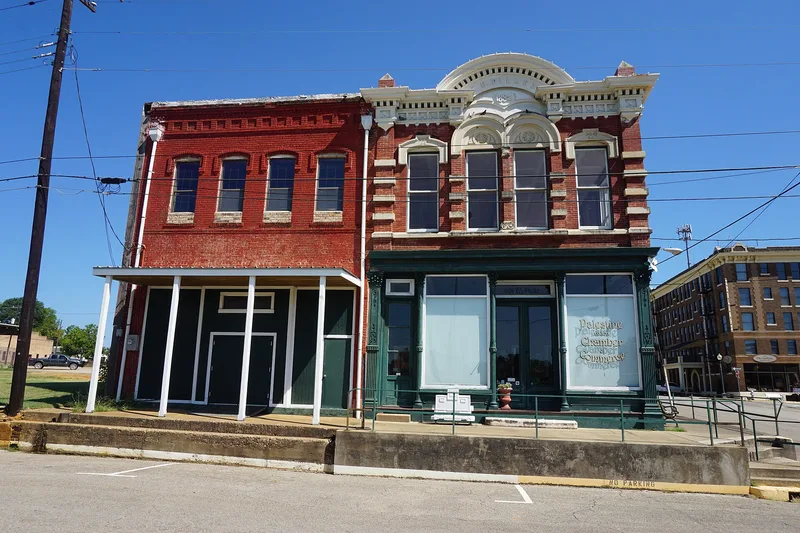
Built in 1882 for George Edward Dilley, a prominent Palestine citizen and son of a successful railroad-building contractor, this two-story brick building stands on a corner lot in downtown Palestine. It is a two-part commercial block with load-bearing masonry walls. The ground floor has a three-bay storefront framed by cast-iron Corinthian pilasters and columns stamped by the Pullman Foundry, while the second floor has carved-stone hoodmolds over its windows. An elaborate parapet carries floral reliefs, dentils, a metal cornice, and a raised inscription of the owner's name and the construction date. Over the years the building housed a boot and shoe store, the post office, a music store with an upstairs music school, and a printing shop. Few Italianate commercial buildings survive in Palestine, and this one is regarded as the city's finest example. Local speculation links its design to architect Nicholas J. Clayton, though no connection has been proven.
Significance in brief: The building is nominated at the local level under Criterion C as an outstanding example of Victorian-era commercial architecture. It is one of the few remaining Italianate commercial structures in Palestine and the city's most outstanding commercial example of the style. A possible but unproven design link to architect Nicholas J. Clayton is also discussed.
Machine-generated summary. This summary was generated by a language model from the official nomination document and has not been reviewed line by line by an editor. It may contain errors. Check the source document before relying on any detail. Source: nomination document (PDF) · National Archives catalog entry. NRHP reference 98000698, listed June 11, 1998. Summary generated October 2026 (model claude-sonnet-5-5, prompt v1.0-2026-10-29, confidence high).
Key facts
| Address | 503 W. Main St., Palestine |
|---|---|
| County | Anderson County |
| Listed | June 11, 1998 |
| Reference number | 98000698 |
| Resource type | Building |
| Period of significance | 1882 |
| Architect / builder | unknown (Clayton, Nicholas J., attributed) |
| Architectural style | Late Victorian: Italianate |
| Criteria |
|
| Areas of significance | Architecture |
| Level of significance | Local |
| Status (as stated in the nomination) | Main section described as vacant and in good condition, with restoration completed in 1993 and further restoration underway by a local service league planning exhibit, conference and office use. |
| Acreage | 0.9 |
| Within district | Palestine New Town Commercial Historic District |
| Coordinates | 31.76244, -95.63487 (NPS GIS) |
What listing means for this property
For an income-producing building, listing (individually or as a contributing building in a district) is the gateway to the 20% federal rehabilitation tax credit on qualified rehabilitation costs, often stackable with state credits. Work claiming the credit must follow the Secretary of the Interior's Standards and be approved in advance.
Listing does not restrict a private owner acting without federal money or permits; where federal funding or licensing is involved, Section 106 review applies.
Noted as vacant in the nomination. Nomination documents can be decades old; current status may differ. If you are considering buying an empty listed property, read the due-diligence checklist.
General information, not legal or tax advice. Rules change; confirm with your State Historic Preservation Office or a qualified adviser.
Sources and further reading
- National Park Service, National Register of Historic Places database (snapshot May 2026), reference 98000698.
- Nomination form (PDF, National Archives) — catalog entry
- Wikidata Q107321115
- This listing as JSON
Last updated October 2026. Found an error? See the editorial policy for how to report it.