First Bank of the United States
Also known as: See Also:Independence National Historical Park

Why it's listed
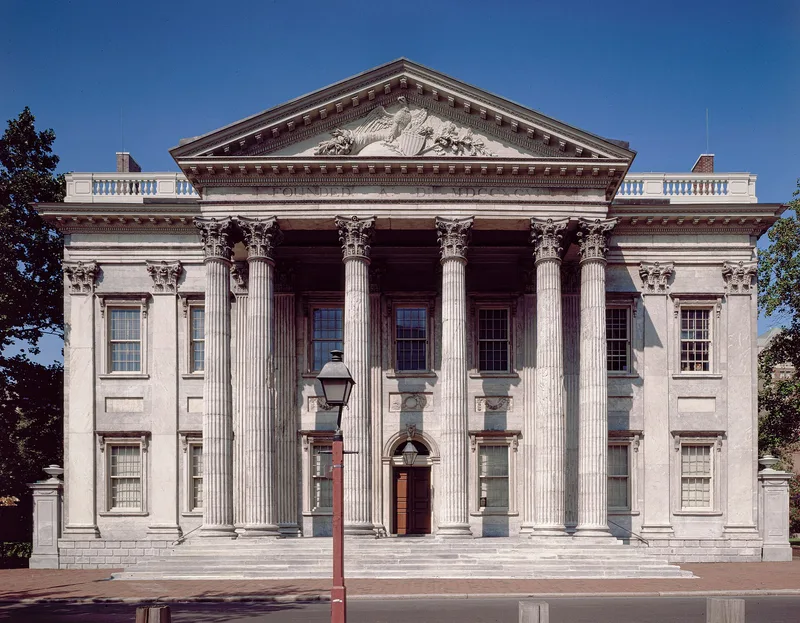
Built on Third Street in Philadelphia and completed in 1797 for the Bank of the United States, this three-story brick building is faced in marble and has a Corinthian hexastyle portico that is 48 by 11 feet. Samuel Blodgett designed it in 1794, and its marble facade is regarded as probably the first important classical marble facade erected in the United States. The bank operated here from 1797 to 1811. The building's significance also lies in the constitutional debate that surrounded its charter. Hamilton's proposal for the bank provoked a dispute with Jefferson and Madison over whether Congress held implied powers under the necessary and proper clause, and Hamilton's argument for broad federal authority was later adopted in McCulloch v. Maryland. After 1811 Stephen Girard's bank occupied the building until 1929. The National Park Service bought it in 1955, and its exterior was restored to the eighteenth-century appearance between 1974 and 1976.
Significance in brief: The nomination argues the building is significant for its architecture, as an early and notable example of Classical monumental design and probably the first important marble classical facade in the United States. It is also tied to the constitutional debate over the chartering of the bank, in which Hamilton's broad reading of federal powers was set against Jefferson's strict construction.
Machine-generated summary. This summary was generated by a language model from the official nomination document and has not been reviewed line by line by an editor. It may contain errors. Check the source document before relying on any detail. Source: nomination document (PDF) · National Archives catalog entry. NRHP reference 87001292, listed May 4, 1987. Summary generated October 2026 (model claude-haiku-5-5, prompt v1.1-2026-10-29, confidence high).
Key facts
| Address | 116 S. Third St., Philadelphia |
|---|---|
| County | Philadelphia |
| Listed | May 4, 1987 |
| Reference number | 87001292 |
| Resource type | Building |
| Period of significance | 1797 |
| Architect / builder | Samuel Blodgett (architect); Claudius F. LeGrand and Sons (stone workers, woodcarvers and guilders) |
| Architectural style | Classical monumental design |
| Criteria |
|
| Areas of significance | Economics, Law, Politics/Government, Architecture |
| Level of significance | National |
| National Historic Landmark | Yes, designated May 4, 1987 |
| Status (as stated in the nomination) | Restored by the National Park Service between 1974 and 1976 with the 1902 interior remodeling retained; the building is used as park offices and library space. |
| Acreage | 0.9 |
| Coordinates | 39.94804, -75.14642 (NPS GIS) |
What listing means for this property
For an income-producing building, listing (individually or as a contributing building in a district) is the gateway to the 20% federal rehabilitation tax credit on qualified rehabilitation costs, often stackable with state credits. Work claiming the credit must follow the Secretary of the Interior's Standards and be approved in advance.
Listing does not restrict a private owner acting without federal money or permits; where federal funding or licensing is involved, Section 106 review applies.
General information, not legal or tax advice. Rules change; confirm with your State Historic Preservation Office or a qualified adviser.
Sources and further reading
- National Park Service, National Register of Historic Places database (snapshot May 2026), reference 87001292.
- Nomination form (PDF, National Archives) — catalog entry
- Wikipedia article (used for cross-checking only; text not reproduced here)
- Wikidata Q934187
- This listing as JSON
Last updated October 2026. Found an error? See the editorial policy for how to report it.