Second Bank of the United States
Also known as: Old Custom House; See Also:Independence National Historical P

Why it's listed
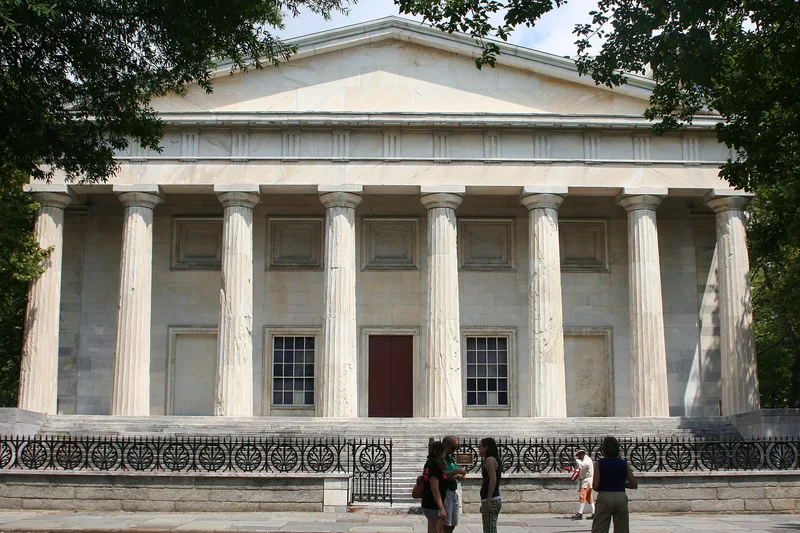
Built between 1819 and 1824 at 420 Chestnut Street in Philadelphia, the Second Bank of the United States is a marble temple modeled on the Parthenon in Athens. William Strickland designed the three-story building, which has a north portico of eight fluted Doric columns and a banking room whose interior Ionic columns and vaulted ceilings survive largely in their original form. Nicholas Biddle led the bank during its most influential years, when it marketed government bonds, served as a depository for federal funds, and regulated state bank notes. Its Greek Revival design was copied for numerous branch banks across the country. The bank's charter expired in 1836 after a long dispute with President Andrew Jackson over its constitutionality and power. The Port of Philadelphia later used the building as a Custom House until 1934. Its significance rests on its role in early national finance and on its architecture, which the nomination regards as among the finest Greek Revival buildings in the country.
Significance in brief: The nomination argues the building is significant for constitutional history, tied to the bank's role in stabilizing national finance and the political fight over its charter under President Andrew Jackson, and for architecture, as one of the finest Greek Revival examples in the United States that served as a model for numerous branch banks.
Machine-generated summary. This summary was generated by a language model from the official nomination document and has not been reviewed line by line by an editor. It may contain errors. Check the source document before relying on any detail. Source: nomination document (PDF) · National Archives catalog entry. NRHP reference 87001293, listed May 4, 1987. Summary generated October 2026 (model claude-haiku-5-5, prompt v1.1-2026-10-29, confidence medium).
Key facts
| Address | 420 Chestnut St., Philadelphia |
|---|---|
| County | Philadelphia |
| Listed | May 4, 1987 |
| Reference number | 87001293 |
| Resource type | Building |
| Period of significance | 1824-1836 |
| Architect / builder | William Strickland |
| Architectural style | Greek Revival |
| Criteria |
|
| Areas of significance | Economics, Law, Politics/Government, Architecture |
| Level of significance | National |
| National Historic Landmark | Yes, designated May 4, 1987 |
| Status (as stated in the nomination) | The building now houses the Independence Park Portrait Collection after restoration work in the 1940s. |
| Acreage | 0.9 |
| Within district | Independence National Historical Park |
| Coordinates | 39.94856, -75.14841 (NPS GIS) |
What listing means for this property
For an income-producing building, listing (individually or as a contributing building in a district) is the gateway to the 20% federal rehabilitation tax credit on qualified rehabilitation costs, often stackable with state credits. Work claiming the credit must follow the Secretary of the Interior's Standards and be approved in advance.
Listing does not restrict a private owner acting without federal money or permits; where federal funding or licensing is involved, Section 106 review applies.
General information, not legal or tax advice. Rules change; confirm with your State Historic Preservation Office or a qualified adviser.
Sources and further reading
- National Park Service, National Register of Historic Places database (snapshot May 2026), reference 87001293.
- Nomination form (PDF, National Archives) — catalog entry
- Wikipedia article (used for cross-checking only; text not reproduced here)
- Wikidata Q2263849
- This listing as JSON
Last updated October 2026. Found an error? See the editorial policy for how to report it.