Fairmount Water Works

Why it's listed
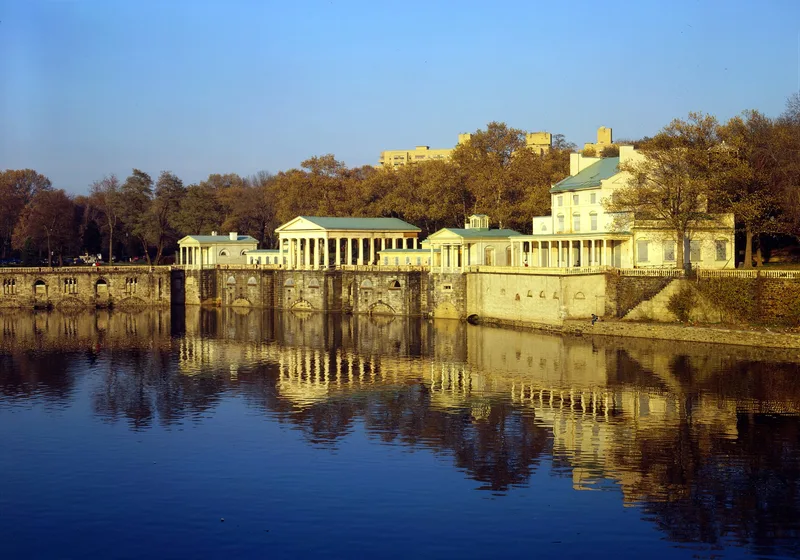
Fairmount Water Works sits on the east bank of the Schuylkill River in Philadelphia, where a dam built in 1819 diverted water into a forebay cut from solid rock. Frederick Graff, a former chief draftsman for Benjamin Latrobe, designed and directed the works, which began pumping water in 1822 and were powered by eight water wheels in a stone mill-house of 238 by 56 feet. The Roman Revival pavilions with Doric porticos at each end reflected the classical style of the period, and the complex was regarded as an early joining of engineering and architecture. Sculptures by William Rush, including Schuylkill Chained and Schuylkill Freed, were placed at its entrances, and the grounds grew into the nucleus of Fairmount Park. The works were closed around 1911 and later converted to an aquarium. Its significance rests on its engineering firsts, its classical design, and its role as an early public landscape in Philadelphia.
Significance in brief: The nomination argues the works were an engineering achievement and an architectural landmark, the first municipal water works in the country to use paddle wheels for pumping and later the first to switch to turbines. Its classical buildings were enhanced by sculpture by William Rush, and its landscaped setting became the nucleus of Fairmount Park.
Machine-generated summary. This summary was generated by a language model from the official nomination document and has not been reviewed line by line by an editor. It may contain errors. Check the source document before relying on any detail. Source: nomination document (PDF) · National Archives catalog entry. NRHP reference 76001662, listed May 11, 1976. Summary generated October 2026 (model claude-haiku-5-5, prompt v1.1-2026-10-29, confidence medium).
Key facts
| Address | E banks of Schuylkill River, Philadelphia |
|---|---|
| County | Philadelphia |
| Listed | May 11, 1976 |
| Reference number | 76001662 |
| Resource type | District |
| Period of significance | 1812-22 |
| Architect / builder | Frederick Graff (1774-1847) |
| Architectural style | Greek Revival |
| Areas of significance | Art, Economics, Military, Transportation, Architecture, Social History |
| Level of significance | National |
| National Historic Landmark | Yes, designated May 11, 1976 |
| Status (as stated in the nomination) | Vacant since 1962, according to the document. |
| Within district | Fairmount Park |
| Coordinates | 39.96586, -75.18483 (NPS GIS) |
What listing means for this property
This is a historic district. Buildings within its boundary are either contributing (they add to the district's significance) or non-contributing. Owners of contributing income-producing buildings can claim the 20% federal rehabilitation tax credit; homeowners should look at state credits. National Register districts impose no design review by themselves; a local historic district ordinance, if one exists, does (the difference explained).
Noted as vacant in the nomination. Nomination documents can be decades old; current status may differ. If you are considering buying an empty listed property, read the due-diligence checklist.
General information, not legal or tax advice. Rules change; confirm with your State Historic Preservation Office or a qualified adviser.
Sources and further reading
- National Park Service, National Register of Historic Places database (snapshot May 2026), reference 76001662.
- Nomination form (PDF, National Archives) — catalog entry
- Wikipedia article (used for cross-checking only; text not reproduced here)
- Wikidata Q5430659
- This listing as JSON
Last updated October 2026. Found an error? See the editorial policy for how to report it.