Boat House Row

Why it's listed
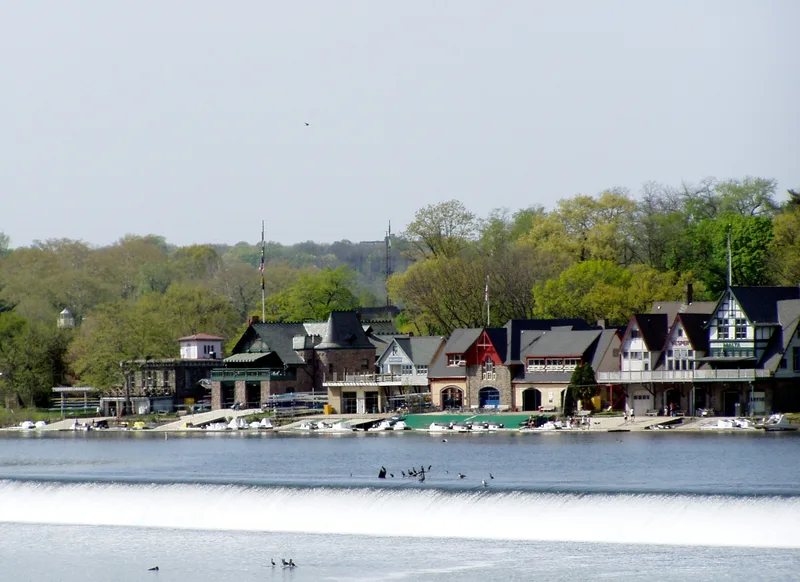
Boat House Row is a row of fifteen boathouses and a skating club building on the east bank of the Schuylkill River north of the Fairmount Water Works in Philadelphia. The first stone houses were erected in 1860 after the city condemned earlier frame and brick structures, and the Fairmount Park Commission later required stone construction for new buildings. Over the following decades the clubs built in a range of styles, from ornamented Victorian Gothic to Georgian and Colonial Revival. Plaisted Hall, built in 1881, and the Fairmount Rowing Association house of 1904 are among the notable buildings. The Row is significant for its link to the Schuylkill Navy, formed in 1858 as the oldest amateur governing body in sports in the United States. Many of its oarsmen became Olympic and national champions, and several member clubs are among the oldest in the country. The architectural variety and the architects involved also set the Row apart from typical utilitarian boathouses.
Significance in brief: The nomination argues the Row is significant for recreation and rowing history, including the Schuylkill Navy, the oldest amateur governing body in sports in the United States, formed in 1858. It also cites the architectural variety of the boathouses and the prominent architects associated with their design.
Machine-generated summary. This summary was generated by a language model from the official nomination document and has not been reviewed line by line by an editor. It may contain errors. Check the source document before relying on any detail. Source: nomination document (PDF) · National Archives catalog entry. NRHP reference 87000821, listed February 27, 1987. Summary generated October 2026 (model claude-haiku-5-5, prompt v1.1-2026-10-29, confidence medium).
Key facts
| Address | 1--15 E. River Dr., Philadelphia |
|---|---|
| County | Philadelphia |
| Listed | February 27, 1987 |
| Reference number | 87000821 |
| Resource type | Building |
| Period of significance | 1860-date |
| Architect / builder | Various (See below) |
| Architectural style | Victorian Gothic, Italianate, Second Empire, Georgian Revival, Colonial Revival, Shingle, Eastlake, Tudor and half-timbered styles |
| Areas of significance | Entertainment/Recreation |
| Level of significance | National |
| National Historic Landmark | Yes, designated February 27, 1987 |
| Status (as stated in the nomination) | The document describes the Row as having preservation problems, including deteriorating stonework, a large crack in brickwork, and poor painting on Plaisted Hall. |
| Acreage | 12 |
| Within district | Fairmount Park |
| Coordinates | 39.96900, -75.18562 (NPS GIS) |
What listing means for this property
National Register listing is honorary for a privately owned home: it does not by itself restrict what an owner may do with their own money, and it does not require public access. Restrictions come from local landmark or historic-district ordinances, which are separate (how they differ).
Owner-occupied houses are not eligible for the 20% federal rehabilitation tax credit, which applies to income-producing buildings, but many states offer credits for homeowners. Listing also opens the door to preservation easements and to buying a plaque. Start with what listing means for homeowners, renovating a listed house and selling one.
General information, not legal or tax advice. Rules change; confirm with your State Historic Preservation Office or a qualified adviser.
Sources and further reading
- National Park Service, National Register of Historic Places database (snapshot May 2026), reference 87000821.
- Nomination form (PDF, National Archives) — catalog entry
- Wikipedia article (used for cross-checking only; text not reproduced here)
- Wikidata Q2907541
- This listing as JSON
Last updated October 2026. Found an error? See the editorial policy for how to report it.