Dobson Mills

Why it's listed
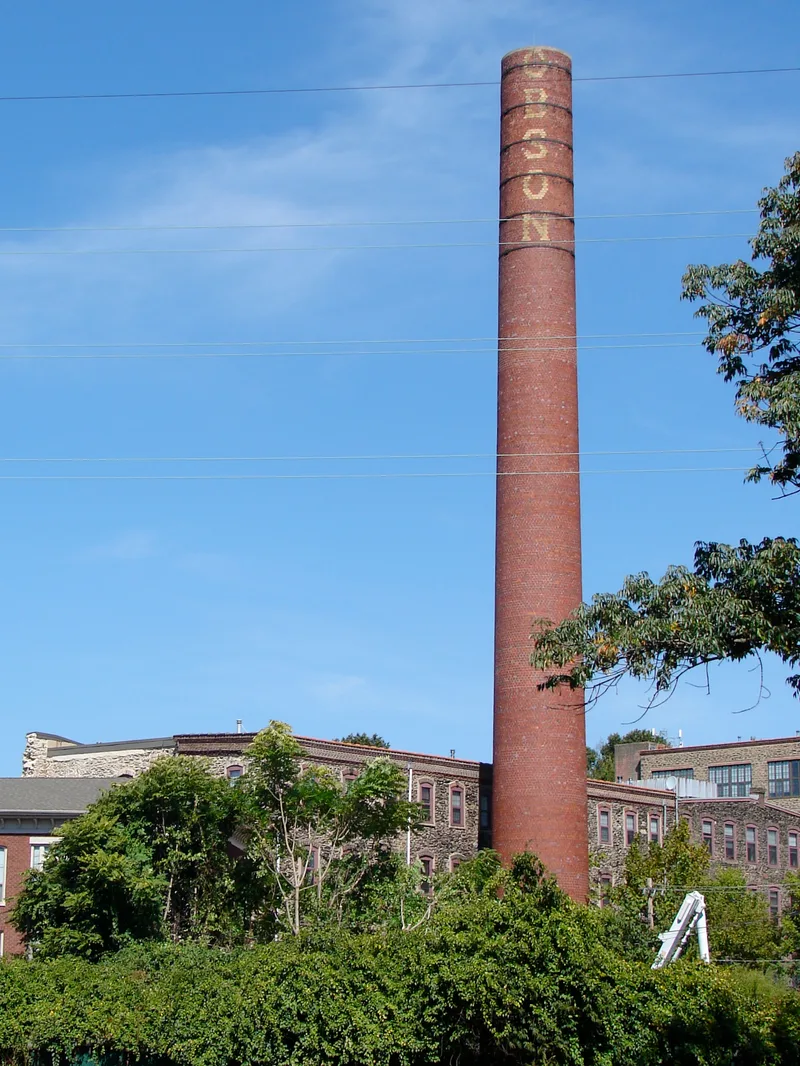
Built on about twenty acres along the Schuylkill River at East Falls, Philadelphia, the Dobson Mills complex grew from a first mill begun in 1858 into six clusters of stone buildings producing wool cloth, blankets, yarns, carpets and plush upholstery fabric. The buildings share local schist and rubble stone, heavy timber framing and arched window heads, and most are two to five stories high. Mill No. 1 produced overcoat cloth and expanded during the Civil War, when the company received large Army blanket orders. By 1890 the company is described as the largest and most diversified woolen mill in the city, with capacity near 200,000 yards of woolens per month. Early buildings reflect barn-like construction, while later additions show fire towers, toilet stacks and concrete work. The complex is regarded as a rare, largely intact record of Philadelphia mill development, with its historical importance tied to the Dobson family's role in regional textile manufacturing.
Significance in brief: The nomination argues the complex is one of the largest and most impressively sited surviving industrial sites from Philadelphia's nineteenth-century textile era, and that it is a largely intact record of early Philadelphia mill design and evolution. It cites the Dobsons' large woolen output, their Civil War blanket contracts, and the scale of employment, which reached about 11,000 by 1911 according to the form.
Machine-generated summary. This summary was generated by a language model from the official nomination document and has not been reviewed line by line by an editor. It may contain errors. Check the source document before relying on any detail. Source: nomination document (PDF) · National Archives catalog entry. NRHP reference 88001214, listed July 28, 1988. Summary generated October 2026 (model claude-haiku-5-5, prompt v1.1-2026-10-29, confidence medium).
Key facts
| Address | 4001--4041 Ridge Ave.; 33502--3530 Scott's La., Philadelphia |
|---|---|
| County | Philadelphia |
| Listed | July 28, 1988 |
| Reference number | 88001214 |
| Resource type | District |
| Period of significance | 1858-1928 |
| Architectural style | Vernacular Mill |
| Criteria |
|
| Areas of significance | Industry, Architecture |
| Level of significance | Local |
| Status (as stated in the nomination) | Document states the ruinous condition of several buildings, subdivision after the Dobsons sold the mill, and that the nineteen contributing buildings, water tank and boiler house smokestack remain. |
| Acreage | 20 |
| Within district | Fairmount Park |
| Coordinates | 40.00796, -75.18707 (NPS GIS) |
What listing means for this property
This is a historic district. Buildings within its boundary are either contributing (they add to the district's significance) or non-contributing. Owners of contributing income-producing buildings can claim the 20% federal rehabilitation tax credit; homeowners should look at state credits. National Register districts impose no design review by themselves; a local historic district ordinance, if one exists, does (the difference explained).
General information, not legal or tax advice. Rules change; confirm with your State Historic Preservation Office or a qualified adviser.
Sources and further reading
- National Park Service, National Register of Historic Places database (snapshot May 2026), reference 88001214.
- Nomination form (PDF, National Archives) — catalog entry
- Wikipedia article (used for cross-checking only; text not reproduced here)
- Wikidata Q5286968
- This listing as JSON
Last updated October 2026. Found an error? See the editorial policy for how to report it.