Chamounix
Also known as: See Also:Fairmount Park

Why it's listed
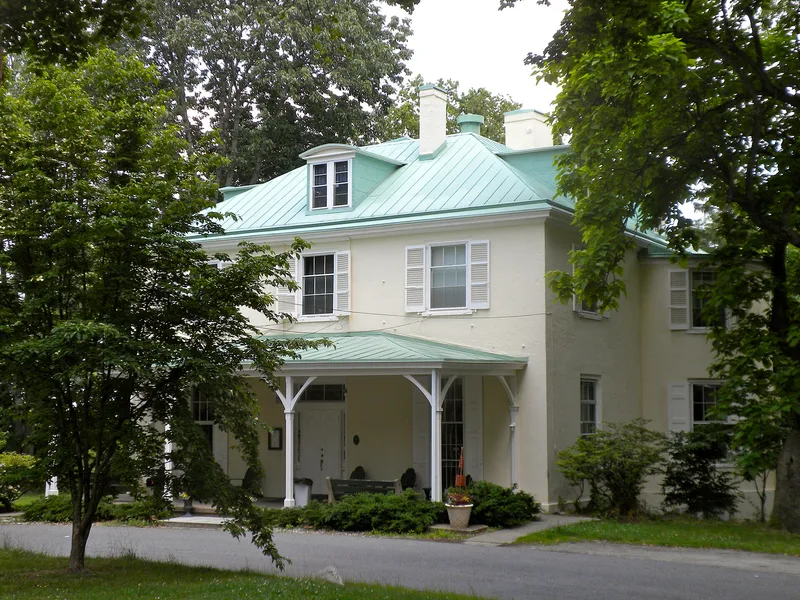
Chamounix is a country house on the Schuylkill River in Philadelphia, built about 1800 by George Plumstead, a merchant in the India trade. It was a small two-story house with a hipped shingle roof and a notable ten-foot bow on the south side, built to take advantage of the view of the falls of the Schuylkill. About 1856, under the ownership of Topliff Johnson, the house was enlarged and given piazzas on three sides with decorative iron supports, and its roof was later replaced with tin. It is significant as one of the country retreats built by prominent Philadelphians after the Revolution, when yellow fever threatened the city. The Johnson heirs lost the land to public appropriation in 1869, and it later became part of Fairmount Park. After years of decline, the house was extensively repaired and opened as a youth hostel in 1964, retaining its facade and interior layout.
Significance in brief: The nomination argues the house is significant as one of the many country estates built by prominent Philadelphians in the post-Revolutionary period, when yellow fever made the city unhealthy. It is also cited as a fine example of adaptive use in historic preservation, having been restored and reopened as a youth hostel in 1964.
Machine-generated summary. This summary was generated by a language model from the official nomination document and has not been reviewed line by line by an editor. It may contain errors. Check the source document before relying on any detail. Source: nomination document (PDF) · National Archives catalog entry. NRHP reference 72001146, listed April 26, 1972. Summary generated October 2026 (model claude-haiku-5-5, prompt v1.1-2026-10-29, confidence medium).
Key facts
| Address | West Fairmount Park on Chamounix Dr., Philadelphia |
|---|---|
| County | Philadelphia |
| Listed | April 26, 1972 |
| Reference number | 72001146 |
| Resource type | Building |
| Period of significance | ca. 1800 |
| Architect / builder | George Plumstead (builder, merchant in the India trade) |
| Criteria |
|
| Areas of significance | Architecture |
| Level of significance | National |
| Status (as stated in the nomination) | Restored and in use as an international youth hostel since 1964, with overnight accommodations for up to 40 guests. |
| Acreage | 0.9 |
| Within district | Fairmount Park |
| Coordinates | 40.00386, -75.18449 (NPS GIS) |
What listing means for this property
National Register listing is honorary: it recognises significance and does not restrict what a private owner may do without federal money or permits. It unlocks the 20% federal rehabilitation tax credit for income-producing buildings, state credits in many states, and Section 106 review when federal agencies are involved. See what listing means in practice.
General information, not legal or tax advice. Rules change; confirm with your State Historic Preservation Office or a qualified adviser.
Sources and further reading
- National Park Service, National Register of Historic Places database (snapshot May 2026), reference 72001146.
- Nomination form (PDF, National Archives) — catalog entry
- Wikipedia article (used for cross-checking only; text not reproduced here)
- Wikidata Q5069846
- This listing as JSON
Last updated October 2026. Found an error? See the editorial policy for how to report it.