Christ Church

Why it's listed
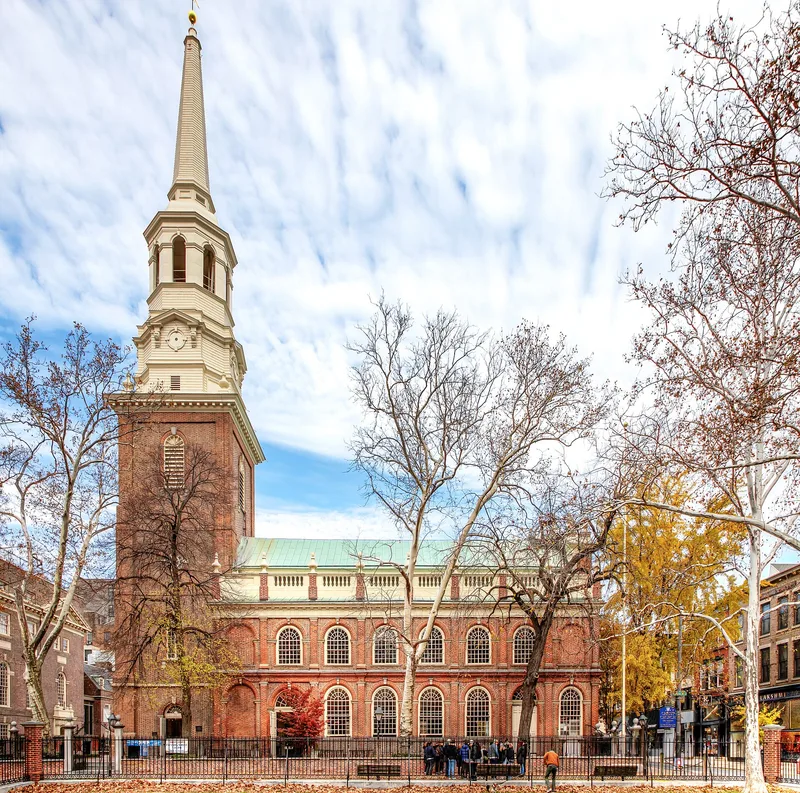
Christ Church stands in Philadelphia as a two-story brick church of Flemish bond with glazed headers, built between 1727 and 1744 on the third church site in the city. Its main body measures 62 by 87 feet, and it is crowned by a 196-foot octagonal wooden steeple on a 28-foot-square tower with stone walls four feet thick. The exterior features a great Palladian window at the east end that lights the chancel, framed by carved keystones, medallions and an Ionic entablature. Inside, three widely spaced Doric columns on each side support a plaster ceiling, and the wine-glass pulpit, reading desk and font date from 1770. The church is regarded as one of the most ornate and largest Georgian churches in the English colonies. Revolutionary-era worshippers included Benjamin Franklin and George Washington, and the Continental Congress met there as a body in July 1775.
Significance in brief: The nomination argues that the church is among the finest and most ornate large Georgian colonial churches in the United States, with Baroque-influenced details such as a great Palladian window and molded brick work. It also cites its association with Philadelphia's wealthy citizens and with Revolutionary-era worshippers, including the Continental Congress in July 1775. The church has been in continuous use since its founding.
Machine-generated summary. This summary was generated by a language model from the official nomination document and has not been reviewed line by line by an editor. It may contain errors. Check the source document before relying on any detail. Source: nomination document (PDF) · National Archives catalog entry. NRHP reference 70000553, listed April 15, 1970. Summary generated October 2026 (model claude-haiku-5-5, prompt v1.1-2026-10-29, confidence high).
Key facts
| Address | 22-26 N. 2nd St., Philadelphia |
|---|---|
| County | Philadelphia |
| Listed | April 15, 1970 |
| Reference number | 70000553 |
| Resource type | Building |
| Period of significance | 1727-1754 |
| Architectural style | Georgian; Baroque influence |
| Criteria |
|
| Areas of significance | Architecture |
| Level of significance | National |
| National Historic Landmark | Yes, designated May 15, 1970 |
| Status (as stated in the nomination) | Still used as an active Episcopal church and maintained in excellent condition. |
| Acreage | 1 |
| Within district | Independence National Historical Park |
| Coordinates | 39.95076, -75.14389 (NPS GIS) |
What listing means for this property
Religious properties are listed for their architectural or historical significance, not their religious use. Listing is honorary and does not restrict the congregation's use of the building. The federal rehabilitation credit is generally unavailable unless part of the building is income-producing; some state programmes and preservation grants do cover religious buildings. Federal funding or permits trigger Section 106 review.
General information, not legal or tax advice. Rules change; confirm with your State Historic Preservation Office or a qualified adviser.
Sources and further reading
- National Park Service, National Register of Historic Places database (snapshot May 2026), reference 70000553.
- Nomination form (PDF, National Archives) — catalog entry
- Wikipedia article (used for cross-checking only; text not reproduced here)
- Wikidata Q979481
- This listing as JSON
Last updated October 2026. Found an error? See the editorial policy for how to report it.