Independence National Historical Park
Also known as: See Also:First Bank of the United States; Second Bank of the

Why it's listed
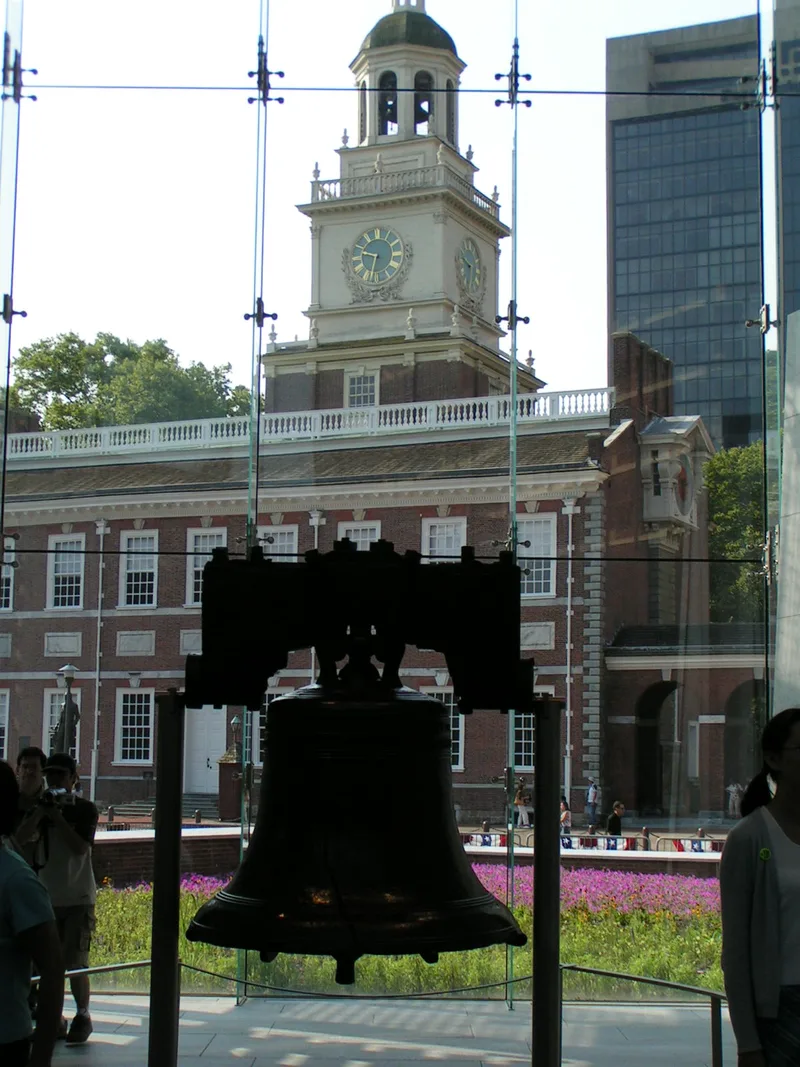
Independence National Historical Park occupies 39.53 acres of downtown Philadelphia, the city that served as the nation's capital from 1790 to 1800. Its core is Independence Hall, where the Second Continental Congress signed the Declaration of Independence in 1776 and the Constitutional Convention met from May 25 to September 17, 1787. Congress Hall, built 1787-89, housed the House of Representatives and Senate during the capital years. The park also includes the reconstructed Graff House, where Thomas Jefferson drafted the Declaration in 1776, and City Tavern, where delegates to the Continental Congresses gathered. Most surviving buildings are red brick Georgian or Federal structures, and the restored sites hold a large collection of about 22,000 artifacts, including the Liberty Bell and portraits by Charles Willson Peale and Gilbert Stuart. Sites of federal executive offices from the 1790s are marked on the ground.
Significance in brief: The park preserves buildings and sites tied to the Continental Congresses, the signing of the Declaration of Independence and the Constitution, the federal government's decade in Philadelphia (1790-1800), and the lives of figures such as Franklin, Jefferson and Bishop William White. Its historic structures are restored to their 1774-1800 period and it holds a large museum and archeological collection. The nomination argues the resources are of outstanding national significance for their association with the nation's founding and growth.
Machine-generated summary. This summary was generated by a language model from the official nomination document and has not been reviewed line by line by an editor. It may contain errors. Check the source document before relying on any detail. Source: nomination document (PDF) · National Archives catalog entry. NRHP reference 66000683, listed October 15, 1966. Summary generated October 2026 (model claude-haiku-5-5, prompt v1.1-2026-10-29, confidence medium).
Key facts
| Address | Bounded by Walnut, 6th, Chestnut, and 2nd Sts., Philadelphia |
|---|---|
| County | Philadelphia |
| Listed | October 15, 1966 |
| Reference number | 66000683 |
| Resource type | District |
| Period of significance | 1774-1824 |
| Architectural style | Georgian and Federal period red brick buildings; marble classical designs at the First and Second Banks and Merchants' Exchange |
| Areas of significance | Historic - Non-Aboriginal, Economics, Politics/Government, Architecture, Black, Law, Social History, Religion, Invention |
| Level of significance | National |
| Status (as stated in the nomination) | The park buildings are maintained in good to excellent condition; Independence Hall has been completely restored, and all historic structures except the Bond House have received at least exterior restoration. |
| Acreage | 39.5 |
| Within district | Old City Historic District |
| Coordinates | 39.95243, -75.14676 (NPS GIS) |
What listing means for this property
This is a historic district. Buildings within its boundary are either contributing (they add to the district's significance) or non-contributing. Owners of contributing income-producing buildings can claim the 20% federal rehabilitation tax credit; homeowners should look at state credits. National Register districts impose no design review by themselves; a local historic district ordinance, if one exists, does (the difference explained).
General information, not legal or tax advice. Rules change; confirm with your State Historic Preservation Office or a qualified adviser.
Sources and further reading
- National Park Service, National Register of Historic Places database (snapshot May 2026), reference 66000683.
- Nomination form (PDF, National Archives) — catalog entry
- Wikipedia article (used for cross-checking only; text not reproduced here)
- Wikidata Q1190282
- This listing as JSON
Last updated October 2026. Found an error? See the editorial policy for how to report it.