Nicholas, Jacob, House
Also known as: Little Stone House Museum

Why it's listed
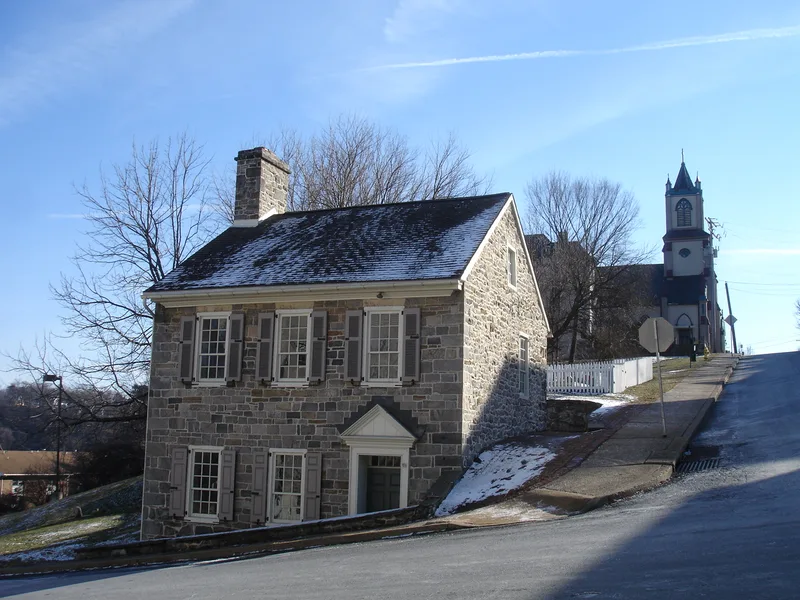
Built into a hillside in Easton around 1750, the Jacob Nicholas House is a two-and-a-half-story stone bank house with three bays on its north facade. Its regularly coursed limestone front contrasts with randomly laid stone on the other walls, and the interior retains original chair rails, baseboards, random-width pine and oak floors, and a stair with square newel and balusters. The attic still has original mortise-and-tenon splayed rafters. Jacob Nicholas, a Durham boat captain, lived here with his wife Margaret and their children, and his son Charles stayed on for several years after Jacob's death in 1832. Easton was home to the largest fleet of Durham boats in the state, which carried trade goods to Philadelphia. Durham boats gained wider fame when General George Washington commandeered a fleet of them to evacuate his troops after the Battle of Trenton. The house is regarded as one of the few Revolutionary-era buildings remaining in Easton and as a typical example of 18th-century small dwellings in the region.
Significance in brief: The nomination describes it as one of about half a dozen buildings in Easton surviving from the Revolutionary era and as a typical 18th-century three-bay small dwelling. It is linked to Jacob Nicholas, a Durham boat captain, and to the Durham boat fleet based in Easton that was used to transport Washington's troops after the Battle of Trenton.
Machine-generated summary. This summary was generated by a language model from the official nomination document and has not been reviewed line by line by an editor. It may contain errors. Check the source document before relying on any detail. Source: nomination document (PDF) · National Archives catalog entry. NRHP reference 76001658, listed November 21, 1976. Summary generated October 2026 (model claude-haiku-5-5, prompt v1.1-2026-10-29, confidence medium).
Key facts
| Address | 458 Ferry St., Easton |
|---|---|
| County | Northampton County |
| Listed | November 21, 1976 |
| Reference number | 76001658 |
| Resource type | Building |
| Period of significance | ca. 1750 |
| Areas of significance | Historic - Non-Aboriginal, Architecture |
| Level of significance | Local |
| Status (as stated in the nomination) | Described as excellent and unaltered but deteriorated, with about 90% of the original structure intact; moisture problems on the ground floor were noted. |
| Acreage | 0.1 |
| Within district | Easton Historic District |
| Coordinates | 40.68942, -75.21265 (NPS GIS) |
What listing means for this property
National Register listing is honorary for a privately owned home: it does not by itself restrict what an owner may do with their own money, and it does not require public access. Restrictions come from local landmark or historic-district ordinances, which are separate (how they differ).
Owner-occupied houses are not eligible for the 20% federal rehabilitation tax credit, which applies to income-producing buildings, but many states offer credits for homeowners. Listing also opens the door to preservation easements and to buying a plaque. Start with what listing means for homeowners, renovating a listed house and selling one.
General information, not legal or tax advice. Rules change; confirm with your State Historic Preservation Office or a qualified adviser.
Sources and further reading
- National Park Service, National Register of Historic Places database (snapshot May 2026), reference 76001658.
- Nomination form (PDF, National Archives) — catalog entry
- Wikipedia article (used for cross-checking only; text not reproduced here)
- Wikidata Q6119047
- This listing as JSON
Last updated October 2026. Found an error? See the editorial policy for how to report it.