Easton House
Also known as: George Taylor's Easton Property

Why it's listed
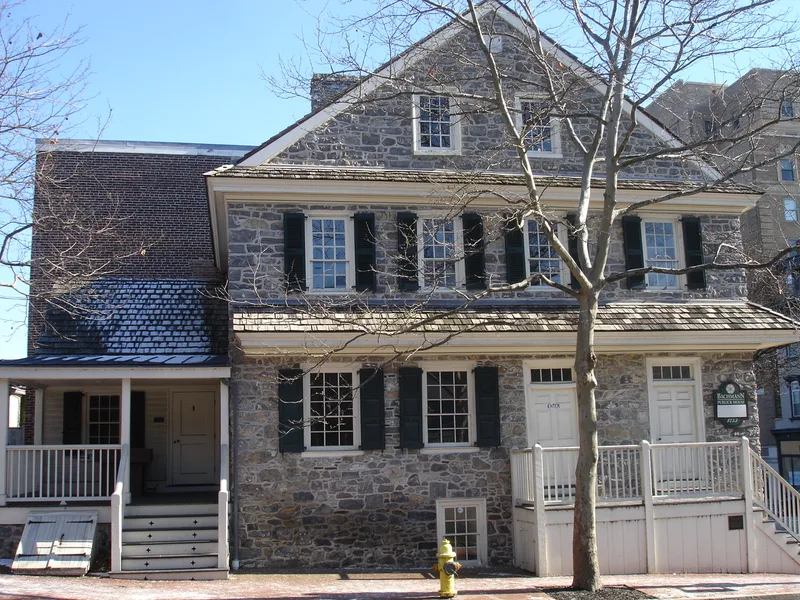
Built in 1754 by Jacob Bachmann on Town Lot No. 24 in Easton, this rubble limestone building with chestnut timber framing began as a tavern and was used for court sessions from its early years until a permanent Court House was completed in 1764. George Taylor, a Signer of the Declaration of Independence, acquired the property in 1761 and expanded it in 1765. During the Revolutionary War it hosted patriots and members of the Second Continental Congress, including William Whipple and William Ellery in 1778. The building retains much of its colonial fabric beneath later stucco, and its interior features are regarded as an important example of Georgian architecture in the Delaware Valley. Its long use as a public house and courthouse links it to the early civic life of Northampton County.
Significance in brief: The nomination describes it as among the most important of Pennsylvania's remaining colonial taverns, citing its association with George Taylor, its Georgian-era architecture of the Delaware Valley variant, and the judicial proceedings and public meetings held there. It is also described as probably the first stone building in Easton and the oldest surviving structure in the city.
Machine-generated summary. This summary was generated by a language model from the official nomination document and has not been reviewed line by line by an editor. It may contain errors. Check the source document before relying on any detail. Source: nomination document (PDF) · National Archives catalog entry. NRHP reference 80003583, listed December 3, 1980. Summary generated October 2026 (model claude-haiku-5-5, prompt v1.1-2026-10-29, confidence medium).
Key facts
| Address | 167-169 Northampton St., Easton |
|---|---|
| County | Northampton County |
| Listed | December 3, 1980 |
| Reference number | 80003583 |
| Resource type | Building |
| Period of significance | 1754-1800 |
| Architect / builder | Jacob Bachmann (builder) |
| Architectural style | Georgian (Delaware Valley variant) |
| Areas of significance | Commerce, Exploration/Settlement, Architecture |
| Level of significance | Local |
| Status (as stated in the nomination) | Described as in good condition, awaiting a projected restoration; currently houses a bar and a small tailor shop. |
| Acreage | 0.1 |
| Within district | Easton Historic District |
| Coordinates | 40.69159, -75.20768 (NPS GIS) |
What listing means for this property
National Register listing is honorary for a privately owned home: it does not by itself restrict what an owner may do with their own money, and it does not require public access. Restrictions come from local landmark or historic-district ordinances, which are separate (how they differ).
Owner-occupied houses are not eligible for the 20% federal rehabilitation tax credit, which applies to income-producing buildings, but many states offer credits for homeowners. Listing also opens the door to preservation easements and to buying a plaque. Start with what listing means for homeowners, renovating a listed house and selling one.
General information, not legal or tax advice. Rules change; confirm with your State Historic Preservation Office or a qualified adviser.
Sources and further reading
- National Park Service, National Register of Historic Places database (snapshot May 2026), reference 80003583.
- Nomination form (PDF, National Archives) — catalog entry
- Wikipedia article (used for cross-checking only; text not reproduced here)
- Wikidata Q5330853
- This listing as JSON
Last updated October 2026. Found an error? See the editorial policy for how to report it.