Black Horse Inn
Also known as: Sampson & the Lion

Why it's listed
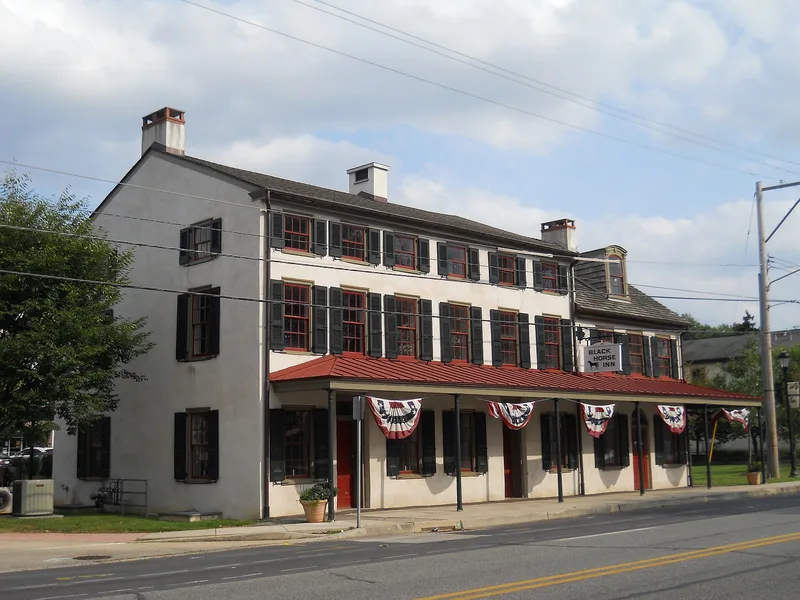
Built in 1744 by Abraham Wakerly, the Black Horse Inn stands on the east side of Bethlehem Pike in Flourtown, Springfield Township, Montgomery County. Its original two-and-a-half-story stone section, finished in stucco, served farmers and lime carriers hauling goods to Philadelphia, and after 1763 it received stagecoach passengers. Jacob Meninger added a three-story section on the north end in 1833, and the building grew to roughly 54 feet along the road. The inn's stabling and adjacent blacksmiths, wheelwrights and harness makers drew much of the commercial trade on the road. From 1901 to 1926 it also served passengers and crews of the trolley line between Philadelphia and Bethlehem. The nomination regards it as significant for its transportation role along the pike and for retaining the form of a typical nineteenth century inn, with its appearance largely unchanged since about 1908.
Significance in brief: The nomination argues the inn is significant for its role on the Bethlehem Pike as one of eight inns serving farmers, lime carriers and travelers, and later stagecoach passengers and trolley crews. It also argues the building retains the form of a typical nineteenth century inn, which gives it architectural significance through its integrity.
Machine-generated summary. This summary was generated by a language model from the official nomination document and has not been reviewed line by line by an editor. It may contain errors. Check the source document before relying on any detail. Source: nomination document (PDF) · National Archives catalog entry. NRHP reference 89000144, listed July 5, 2005. Summary generated October 2026 (model claude-haiku-5-5, prompt v1.1-2026-10-29, confidence medium).
Key facts
| Address | 1432 Bethlehem Pike, Flourtown |
|---|---|
| County | Montgomery County |
| Listed | July 5, 2005 |
| Reference number | 89000144 |
| Resource type | Building |
| Period of significance | 1744-1926 |
| Architect / builder | Abraham Wakerly (builder of 1744 section); Jacob Meninger (1833 addition) |
| Architectural style | Federal |
| Criteria |
|
| Areas of significance | Transportation, Architecture |
| Level of significance | Local |
| Status (as stated in the nomination) | The document describes the building as continuously operated as a transportation center; it does not state a current condition or use. |
| Acreage | 2 |
| Coordinates | 40.10378, -75.21292 (NPS GIS) |
What listing means for this property
For an income-producing building, listing (individually or as a contributing building in a district) is the gateway to the 20% federal rehabilitation tax credit on qualified rehabilitation costs, often stackable with state credits. Work claiming the credit must follow the Secretary of the Interior's Standards and be approved in advance.
Listing does not restrict a private owner acting without federal money or permits; where federal funding or licensing is involved, Section 106 review applies.
General information, not legal or tax advice. Rules change; confirm with your State Historic Preservation Office or a qualified adviser.
Sources and further reading
- National Park Service, National Register of Historic Places database (snapshot May 2026), reference 89000144.
- Nomination form (PDF, National Archives) — catalog entry
- Wikipedia article (used for cross-checking only; text not reproduced here)
- Wikidata Q4921005
- This listing as JSON
Last updated October 2026. Found an error? See the editorial policy for how to report it.