General Washington Inn

Why it's listed
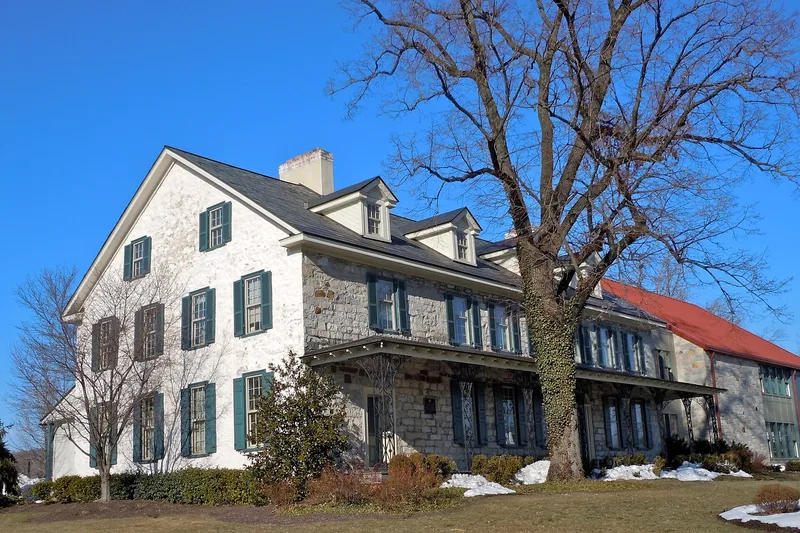
Built in 1761 as an inn, this two-story structure of cut and dressed quarried limestone sits on the Philadelphia-Lancaster pike, a main road between two colonial cities. It was originally a tavern kept by John Downing, a Quaker whose beliefs are reflected in the plain Georgian construction. Known during the colonial period as King in Arms or King George, it took the name General Washington Inn after the Revolutionary War. During the war it served as a food commissary for troops. It also housed the first post office in Chester County, with Hunt Downing appointed postmaster in 1796. Stagecoach traffic changed horses and drivers here at the halfway point between Philadelphia and Lancaster. The inn is the only surviving building of its original complex of barns and stables, and it is regarded as a well-preserved example of an early inn on this route.
Significance in brief: The nomination argues that the inn was an early commercial establishment on the Philadelphia-Lancaster pike that served as a food commissary during the Revolution. It also states that the first post office in Chester County was housed there, with Hunt Downing appointed postmaster in 1796. The building is presented as a well-preserved example of an early inn.
Machine-generated summary. This summary was generated by a language model from the official nomination document and has not been reviewed line by line by an editor. It may contain errors. Check the source document before relying on any detail. Source: nomination document (PDF) · National Archives catalog entry. NRHP reference 79002197, listed August 22, 1979. Summary generated October 2026 (model claude-haiku-5-5, prompt v1.1-2026-10-29, confidence medium).
Key facts
| Address | Uwchlan and E. Lancaster Aves., Downingtown |
|---|---|
| County | Chester County |
| Listed | August 22, 1979 |
| Reference number | 79002197 |
| Resource type | Building |
| Period of significance | 1700-1799 |
| Architectural style | Georgian with Federal-style changes in the mid-19th century |
| Criteria |
|
| Areas of significance | Commerce, Military, Transportation |
| Level of significance | Local |
| Status (as stated in the nomination) | Only the inn remains of the original complex of buildings; the document describes the interior chimneys on the east and west ends as reconstructed. |
| Acreage | 1.8 |
| Within district | East Lancaster Avenue Historic District |
| Coordinates | 40.01147, -75.69540 (NPS GIS) |
What listing means for this property
For an income-producing building, listing (individually or as a contributing building in a district) is the gateway to the 20% federal rehabilitation tax credit on qualified rehabilitation costs, often stackable with state credits. Work claiming the credit must follow the Secretary of the Interior's Standards and be approved in advance.
Listing does not restrict a private owner acting without federal money or permits; where federal funding or licensing is involved, Section 106 review applies.
General information, not legal or tax advice. Rules change; confirm with your State Historic Preservation Office or a qualified adviser.
Sources and further reading
- National Park Service, National Register of Historic Places database (snapshot May 2026), reference 79002197.
- Nomination form (PDF, National Archives) — catalog entry
- Wikipedia article (used for cross-checking only; text not reproduced here)
- Wikidata Q5532285
- This listing as JSON
Last updated October 2026. Found an error? See the editorial policy for how to report it.