Deutschtown Historic District
Also known as: Pittsburgh's East North Side Neighborhood; Dutchtown

Why it's listed
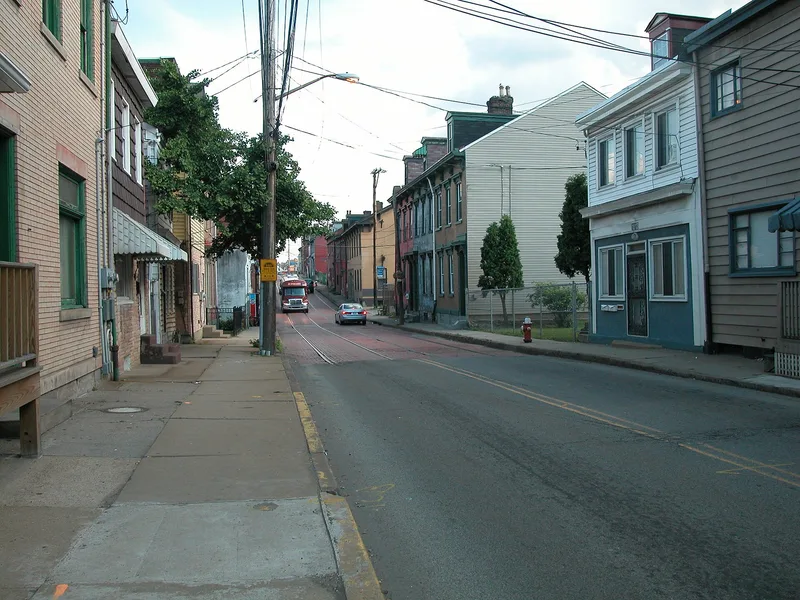
Along the northern edge of the East Commons park in Pittsburgh's North Side, this district of about 550 buildings dates mainly from the 1850s to the early 1900s. Rows of brick and stone rowhouses with stoops face the park along Cedar Avenue, while East Ohio Street holds a commercial wall of two to five-story buildings ranging from Italianate to Second Empire and Queen Anne styles. The district takes its name from a mispronunciation of Deutschtown, reflecting the German immigrants who settled here during the nineteenth century. East Ohio Street served as the central shopping area for much of the North Side into the 1940s. The area's integrity, its homogeneous building stock, and its strong ties to the adjoining park are the main reasons it was recognized as a significant historic place. Its commercial row is noted as one of the few early commercial groupings surviving in Pittsburgh.
Significance in brief: The district is regarded as a fine and homogeneous collection of nineteenth and early twentieth century buildings with generally good integrity. Its East Ohio Street commercial row is described as one of the few extant early commercial rows in Pittsburgh, and the neighborhood's German character and ethnic associations, along with its role as a shopping center for the North Side, are cited as further grounds for significance.
Machine-generated summary. This summary was generated by a language model from the official nomination document and has not been reviewed line by line by an editor. It may contain errors. Check the source document before relying on any detail. Source: nomination document (PDF) · National Archives catalog entry. NRHP reference 83004181, listed November 25, 1983. Summary generated October 2026 (model claude-haiku-5-5, prompt v1.1-2026-10-29, confidence medium).
Key facts
| Address | Roughly bounded by Cedar Ave., Knoll, East, and Pressley Sts., Pittsburgh |
|---|---|
| County | Allegheny County |
| Listed | November 25, 1983 |
| Reference number | 83004181 |
| Resource type | District |
| Period of significance | c. 1840-1920 |
| Architectural style | Italianate, Second Empire, Queen Anne, Romanesque Revival, Romanesque Renaissance Revival, Gothic Revival |
| Areas of significance | Architecture |
| Level of significance | Local |
| Acreage | 37 |
| Within district | Mexican War Streets Historic District, |
| Coordinates | 40.45515, -80.00857 (NPS GIS) |
What listing means for this property
This is a historic district. Buildings within its boundary are either contributing (they add to the district's significance) or non-contributing. Owners of contributing income-producing buildings can claim the 20% federal rehabilitation tax credit; homeowners should look at state credits. National Register districts impose no design review by themselves; a local historic district ordinance, if one exists, does (the difference explained).
General information, not legal or tax advice. Rules change; confirm with your State Historic Preservation Office or a qualified adviser.
Sources and further reading
- National Park Service, National Register of Historic Places database (snapshot May 2026), reference 83004181.
- Nomination form (PDF, National Archives) — catalog entry
- Wikipedia article (used for cross-checking only; text not reproduced here)
- Wikidata Q5327683
- This listing as JSON
Last updated October 2026. Found an error? See the editorial policy for how to report it.