Glendale Cemetery
Also known as: Akron Rural Cemetery

Why it's listed
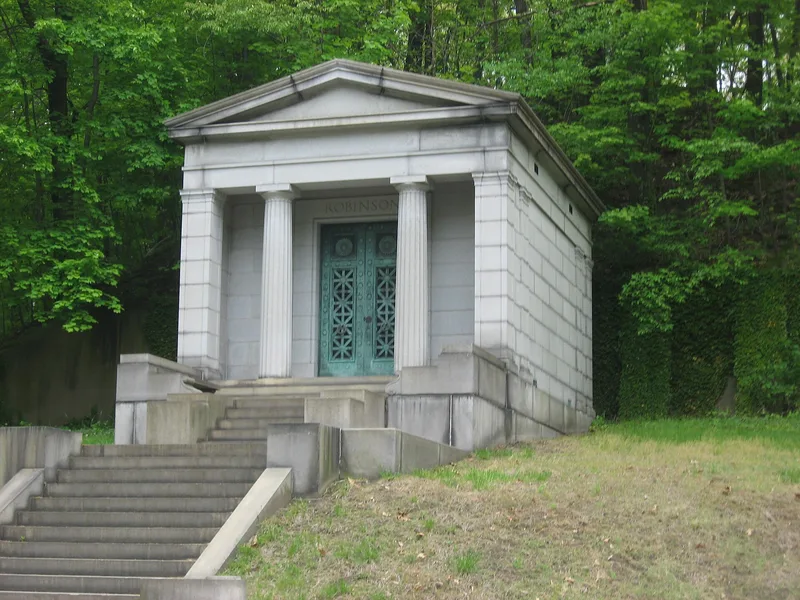
Glendale Cemetery is an 88-acre burial ground in Akron, Ohio, designed in the picturesque manner of the nineteenth-century Rural Cemetery Movement. It started as the Akron Rural Cemetery, took in the eight-acre Oak Openings cemetery in 1850, and gained a western section shortly before 1891. Hills and plateaus flank a central valley that opens into a broad meadow, and Cypress Avenue winds through as the main spine. Along it stand mausoleums in Classical, Egyptian, Gothic, Romanesque, Arts and Crafts and Moderne styles, many with bronze doors, marble interiors and stained glass. The oldest, the Commins vault of 1860, shows Egyptian Revival influence. Four earlier-listed structures stand near the entrance: an office building, a caretaker's residence, a memorial chapel and a bell tower. The cemetery was recognized for its landscape design, its architecture, and its connection to Akron's social history, with a significance period of 1839 to 1929.
Significance in brief: The nomination argues the cemetery is significant under Criteria A and C for its role in social history, health and medicine, recreation, landscape architecture and architecture. Its hilly, curving landscape and its many mausoleums in Classical, Egyptian, Gothic, Romanesque, Arts and Crafts and Moderne styles illustrate rural cemetery design and Akron's affluent society. Its period of significance runs from 1839 to 1929.
Machine-generated summary. This summary was generated by a language model from the official nomination document and has not been reviewed line by line by an editor. It may contain errors. Check the source document before relying on any detail. Source: nomination document (PDF) · National Archives catalog entry. NRHP reference 01001063, listed September 28, 2001. Summary generated October 2026 (model claude-sonnet-5-5, prompt v1.0-2026-10-29, confidence medium).
Key facts
| Address | 150 Glendale Ave., Akron |
|---|---|
| County | Summit County |
| Listed | September 28, 2001 |
| Reference number | 01001063 |
| Resource type | District |
| Period of significance | 1839 - 1929 |
| Architect / builder | Albert Sargent, Thomas Mills |
| Architectural style | Other: Rural Cemetery |
| Criteria |
|
| Areas of significance | Social History, Health/Medicine, Entertainment/Recreation, Landscape Architecture, Architecture |
| Level of significance | Local |
| Status (as stated in the nomination) | Still in use as a cemetery; a garage maintenance building is noted as non-contributing, and the Willow Brook stream and its two lakes no longer exist. |
| Acreage | 88 |
| Coordinates | 41.08431, -81.52882 (NPS GIS) |
What listing means for this property
This is a historic district. Buildings within its boundary are either contributing (they add to the district's significance) or non-contributing. Owners of contributing income-producing buildings can claim the 20% federal rehabilitation tax credit; homeowners should look at state credits. National Register districts impose no design review by themselves; a local historic district ordinance, if one exists, does (the difference explained).
General information, not legal or tax advice. Rules change; confirm with your State Historic Preservation Office or a qualified adviser.
Sources and further reading
- National Park Service, National Register of Historic Places database (snapshot May 2026), reference 01001063.
- Nomination form (PDF, National Archives) — catalog entry
- Wikipedia article (used for cross-checking only; text not reproduced here)
- Wikidata Q5568348
- This listing as JSON
Last updated October 2026. Found an error? See the editorial policy for how to report it.