St. John's Episcopal Church

Why it's listed
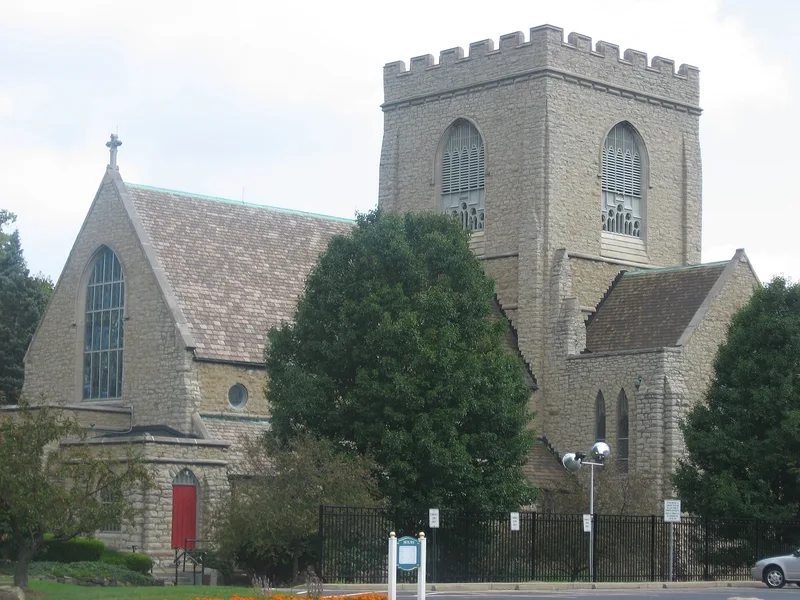
St. John's Episcopal Church occupies a 1.768-acre site at 323 Wick Avenue in Youngstown, home to a congregation founded in 1859. The church was built between 1897 and 1901 from rock-faced Pennsylvania limestone to designs by William Halsey Wood, in an English-based Jacobethan style. It has a Latin cross plan, a crenellated central tower, strap buttresses, lancet windows, a timber roof and slate-covered gables. In 1928-1929 the firm of Cram and Ferguson added the Edward L. Ford Memorial Parish House, a Tudor Revival building faced in limestone, linked to the church by a half-timber and stucco bridge over a porte-cochere. The church is significant for its architecture and for its stained glass, including Tiffany Studio windows installed from 1901 onward, which reflect the artistic tastes of Youngstown's prosperous industrial families. The exterior has changed little, and the building remains in religious use near Youngstown State University.
Significance in brief: The nomination presents the church as a notable example of English-based Jacobethan/Arts and Crafts church architecture by William Halsey Wood, later extended by Cram and Ferguson with a parish house and bridge. It also holds important stained glass, including Tiffany Studio windows, and reflects the tastes and Pittsburgh ties of Youngstown's wealthy industrial families.
Machine-generated summary. This summary was generated by a language model from the official nomination document and has not been reviewed line by line by an editor. It may contain errors. Check the source document before relying on any detail. Source: nomination document (PDF) · National Archives catalog entry. NRHP reference 11001093, listed February 3, 2012. Summary generated October 2026 (model claude-sonnet-5-5, prompt v1.0-2026-10-29, confidence medium).
Key facts
| Address | 323 Wick Ave., Youngstown |
|---|---|
| County | Mahoning County |
| Listed | February 3, 2012 |
| Reference number | 11001093 |
| Resource type | Building |
| Architect / builder | William Halsey Wood (church); Cram and Ferguson (parish house and bridge) |
| Architectural style | Late 19th and 20th Century Revivals: Jacobethan Revival, Tudor Revival |
| Areas of significance | Architecture, Art, Religion |
| Level of significance | Local |
| Status (as stated in the nomination) | Congregation founded in 1859; the complex remains in religious use as a church. The exterior survives with little change. |
| Acreage | 1.8 |
| Coordinates | 41.10347, -80.64595 (NPS GIS) |
What listing means for this property
Religious properties are listed for their architectural or historical significance, not their religious use. Listing is honorary and does not restrict the congregation's use of the building. The federal rehabilitation credit is generally unavailable unless part of the building is income-producing; some state programmes and preservation grants do cover religious buildings. Federal funding or permits trigger Section 106 review.
General information, not legal or tax advice. Rules change; confirm with your State Historic Preservation Office or a qualified adviser.
Sources and further reading
- National Park Service, National Register of Historic Places database (snapshot May 2026), reference 11001093.
- Nomination form (PDF, National Archives) — catalog entry
- Wikidata Q125472561
- This listing as JSON
Last updated October 2026. Found an error? See the editorial policy for how to report it.