Prospect Hill Historic District
Also known as: See Also: Pendleton, George Hunt, House

Why it's listed
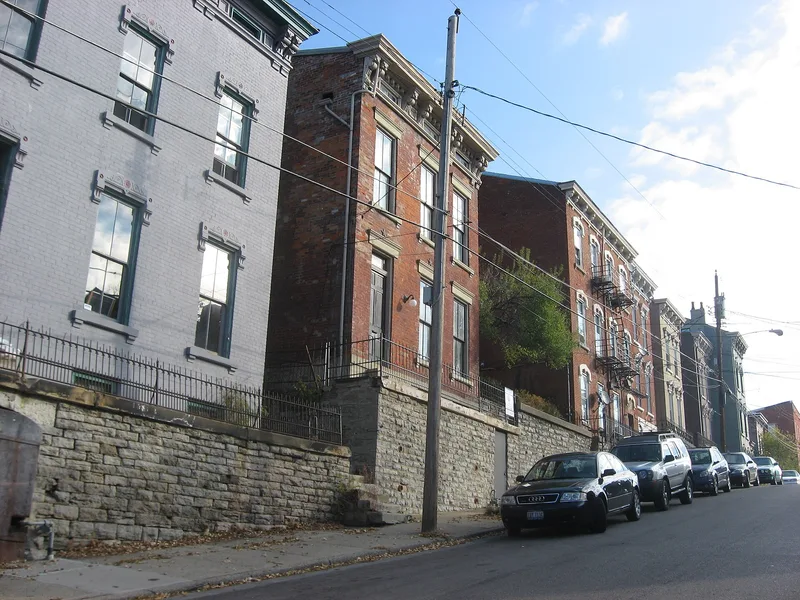
Prospect Hill is a compact residential neighborhood of about 275 buildings climbing the southern slope of Mt. Auburn in Cincinnati. Platted in 1830 by Boal and Slack, it was the first of the city's hillsides to be settled. Its tall, narrow brick houses sit on lots only 25 to 30 feet wide and follow the slope, with retaining walls, stairways and unbuilt "paper streets" reflecting the steep terrain. Greek Revival houses from about 1839 to 1850 mark the earliest phase, Italianate rows from the 1860s and 1870s dominate, and Queen Anne buildings from 1880 to 1895 cluster in the northeast. Landmarks include the 1867 First District School and the George Pendleton House, a National Historic Landmark. Settlers of English descent gave way to German immigrants from about 1840, and the ward was around 70 percent German in 1890. The district is valued for its consistent scale, materials and sense of place.
Significance in brief: The nomination argues the district embodies distinctive nineteenth-century architecture, with Greek Revival, Italianate and Queen Anne buildings forming cohesive streetscapes. It was the first of Cincinnati's hillsides to be settled, and its steep terrain shaped its buildings and streets. It also housed a largely German population through the 1800s.
Machine-generated summary. This summary was generated by a language model from the official nomination document and has not been reviewed line by line by an editor. It may contain errors. Check the source document before relying on any detail. Source: nomination document (PDF) · National Archives catalog entry. NRHP reference 80003078, listed September 4, 1980. Summary generated October 2026 (model claude-sonnet-5-5, prompt v1.0-2026-10-29, confidence medium).
Key facts
| Address | Roughly bounded by Liberty Hill, Highland, Pueblo, Channing, and Sycamore Sts., Cincinnati |
|---|---|
| County | Hamilton County |
| Listed | September 4, 1980 |
| Reference number | 80003078 |
| Resource type | District |
| Period of significance | circa 1830 - present |
| Architectural style | Greek Revival, Italianate, Queen Anne |
| Areas of significance | Architecture |
| Level of significance | Local |
| Status (as stated in the nomination) | Occupied, mainly private residences; condition marked excellent, good and deteriorated; area has seen intensive revitalization and the 1867 First District School was being renovated. |
| Acreage | 36 |
| Within district | Over-the-Rhine Historic District |
| Coordinates | 39.11361, -84.50697 (NPS GIS) |
What listing means for this property
This is a historic district. Buildings within its boundary are either contributing (they add to the district's significance) or non-contributing. Owners of contributing income-producing buildings can claim the 20% federal rehabilitation tax credit; homeowners should look at state credits. National Register districts impose no design review by themselves; a local historic district ordinance, if one exists, does (the difference explained).
General information, not legal or tax advice. Rules change; confirm with your State Historic Preservation Office or a qualified adviser.
Sources and further reading
- National Park Service, National Register of Historic Places database (snapshot May 2026), reference 80003078.
- Nomination form (PDF, National Archives) — catalog entry
- Wikidata Q49546367
- This listing as JSON
Last updated October 2026. Found an error? See the editorial policy for how to report it.