Power Building
Also known as: Ham-5450-44

Why it's listed
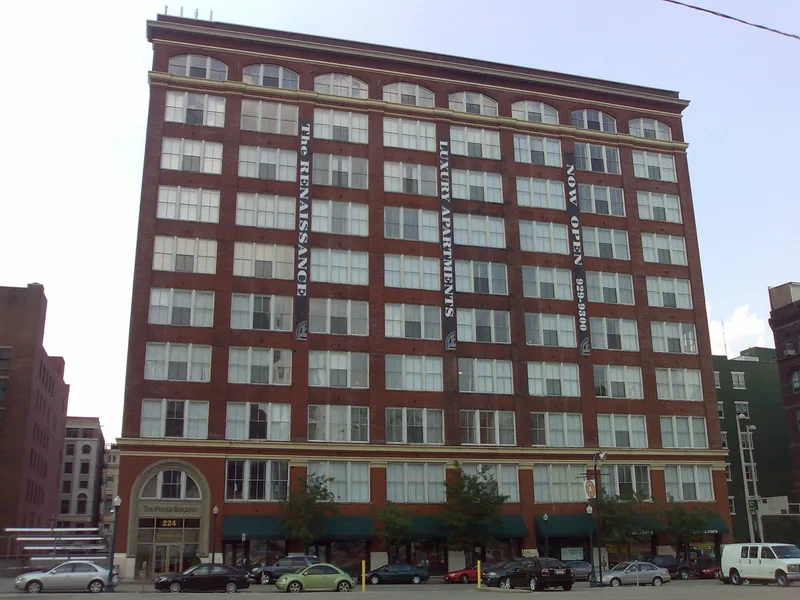
Rising ten stories at the corner of Sycamore and East Eighth Streets in downtown Cincinnati, this brick building was completed in 1903 for industrial tenants. Cincinnati architect Harry Hake designed it early in his career. Its steel frame, pier-and-spandrel walls, three-part facade of base, middle floors and top floor, and tripartite windows are typical of Commercial style design, with Romanesque and Renaissance Revival touches at the entry and top floor. The name comes from its basement power plant, where a coal-fired steam engine drove a generator to supply electricity to tenants. It is the oldest surviving Cincinnati building known to have made its own power. Early occupants included printers, a book company and clothing manufacturers, and garment makers remained common for decades. It is the only surviving large industrial building in the city built in this style. Its scale and its link to Hake's growing firm supported its listing for architecture. The building is now vacant.
Significance in brief: The building is significant under Criterion C as an early work of Cincinnati architect Harry Hake and as a distinctive example of Commercial style architecture applied to a large industrial building. It is the only surviving example of its style and scale among early twentieth century industrial buildings downtown. It is also the oldest surviving Cincinnati building that generated its own electricity, which gave it its name.
Machine-generated summary. This summary was generated by a language model from the official nomination document and has not been reviewed line by line by an editor. It may contain errors. Check the source document before relying on any detail. Source: nomination document (PDF) · National Archives catalog entry. NRHP reference 99000276, listed March 5, 1999. Summary generated October 2026 (model claude-sonnet-5-5, prompt v1.0-2026-10-29, confidence high).
Key facts
| Address | 224 E. 8th St., Cincinnati |
|---|---|
| County | Hamilton County |
| Listed | March 5, 1999 |
| Reference number | 99000276 |
| Resource type | Building |
| Period of significance | 1903 |
| Architect / builder | Architect: Harry Hake (Harry Hake and Partners); built by the Power Building Company |
| Architectural style | Late 19th and Early 20th Century American Movements: Commercial Style |
| Criteria |
|
| Areas of significance | Architecture |
| Level of significance | Local |
| Status (as stated in the nomination) | Listed current function is vacant/not in use; the last tenant was Polly Flinders, a maker of girls' dresses. |
| Acreage | 0.9 |
| Coordinates | 39.10529, -84.50894 (NPS GIS) |
What listing means for this property
For an income-producing building, listing (individually or as a contributing building in a district) is the gateway to the 20% federal rehabilitation tax credit on qualified rehabilitation costs, often stackable with state credits. Work claiming the credit must follow the Secretary of the Interior's Standards and be approved in advance.
Listing does not restrict a private owner acting without federal money or permits; where federal funding or licensing is involved, Section 106 review applies.
Noted as vacant in the nomination. Nomination documents can be decades old; current status may differ. If you are considering buying an empty listed property, read the due-diligence checklist.
General information, not legal or tax advice. Rules change; confirm with your State Historic Preservation Office or a qualified adviser.
Sources and further reading
- National Park Service, National Register of Historic Places database (snapshot May 2026), reference 99000276.
- Nomination form (PDF, National Archives) — catalog entry
- Wikipedia article (used for cross-checking only; text not reproduced here)
- Wikidata Q14716787
- This listing as JSON
Last updated October 2026. Found an error? See the editorial policy for how to report it.