Lane, Joel, House
Also known as: Wakefield

Why it's listed
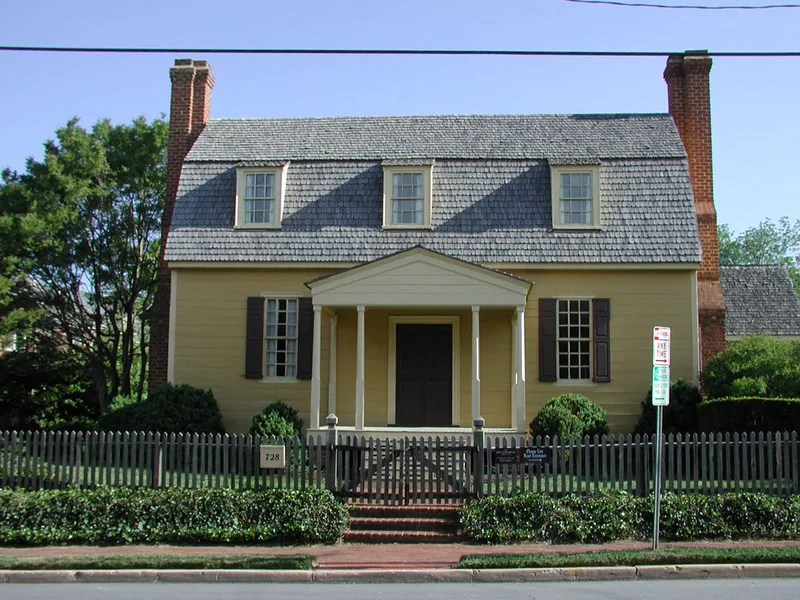
Built before 1760 near what is now Morgan Street and South Boylan Avenue in Raleigh, this story-and-a-half frame house was the home of Joel Lane, one of Wake County's earliest settlers. Lane named it "Wakefield." The main block is three bays wide with a gambrel roof and shed dormers, and inside it has a center passage plan with simple mantels and six-panel doors. The house was the largest dwelling in the crossroads hamlet of Bloomsbury. Lane served in the General Assembly, helped lay out Wake County, and hosted the state committee of safety in 1776 and a General Assembly session in 1781. In 1792 commissioners met at the house and bought Lane's 1,000-acre tract for the state capital, Raleigh. The Boylan family owned the house until 1909. In 1927 the Colonial Dames moved it about 100 yards west to Hargett Street, where it is maintained as a historic site and museum.
Significance in brief: The house was the home of Joel Lane, an early Wake County settler and legislator. It stood at the crossroads hamlet of Bloomsbury, where the state committee of safety and the General Assembly met. Commissioners chose Lane's 1,000-acre tract in 1792 for the new capital, Raleigh.
Machine-generated summary. This summary was generated by a language model from the official nomination document and has not been reviewed line by line by an editor. It may contain errors. Check the source document before relying on any detail. Source: nomination document (PDF) · National Archives catalog entry. NRHP reference 70000472, listed July 28, 1970. Summary generated October 2026 (model claude-sonnet-5-5, prompt v1.0-2026-10-29, confidence medium).
Key facts
| Address | 728 W. Hargett St., Raleigh |
|---|---|
| County | Wake County |
| Listed | July 28, 1970 |
| Reference number | 70000472 |
| Resource type | Building |
| Architect / builder | Joel Lane (builder) |
| Areas of significance | Politics/Government |
| Level of significance | State |
| Status (as stated in the nomination) | Good condition; altered and moved. Owned by the Colonial Dames and operated as a historic site and museum, with restoration work ongoing at the time of nomination. |
| Acreage | 0.5 |
| Coordinates | 35.77793, -78.65056 (NPS GIS) |
What listing means for this property
National Register listing is honorary for a privately owned home: it does not by itself restrict what an owner may do with their own money, and it does not require public access. Restrictions come from local landmark or historic-district ordinances, which are separate (how they differ).
Owner-occupied houses are not eligible for the 20% federal rehabilitation tax credit, which applies to income-producing buildings, but many states offer credits for homeowners. Listing also opens the door to preservation easements and to buying a plaque. Start with what listing means for homeowners, renovating a listed house and selling one.
General information, not legal or tax advice. Rules change; confirm with your State Historic Preservation Office or a qualified adviser.
Sources and further reading
- National Park Service, National Register of Historic Places database (snapshot May 2026), reference 70000472.
- Nomination form (PDF, National Archives) — catalog entry
- Wikipedia article (used for cross-checking only; text not reproduced here)
- Wikidata Q6213673
- This listing as JSON
Last updated October 2026. Found an error? See the editorial policy for how to report it.