Elmwood

Why it's listed
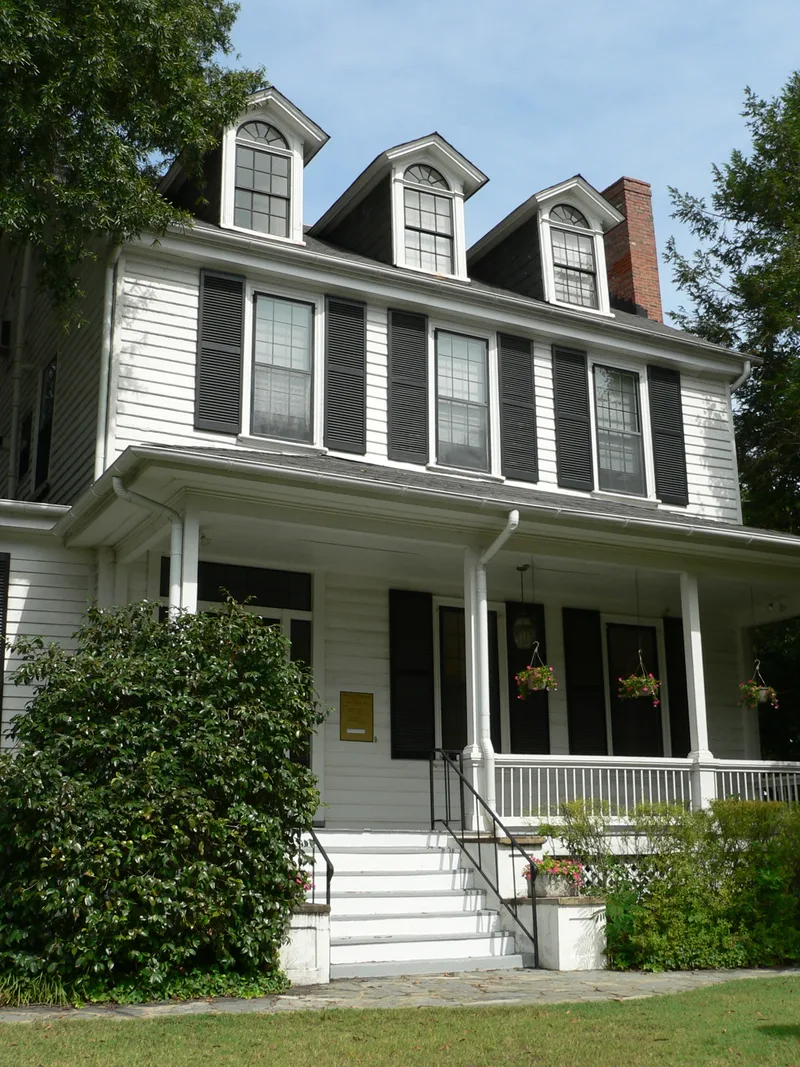
Elmwood is a Federal town house on North Boylan Avenue in Raleigh, begun around 1810-1815 on land John Louis Taylor bought in 1813. The original block is two and a half stories with a side-hall plan, two rooms deep, a gable roof with dormers, and a fieldstone basement. Inside are a mahogany stair, an elliptical hall arch and finely carved mantels. Later owners added wings, a porch and other rooms, giving the rear a complex massing. The house is notable for the men who lived there. Taylor became the first chief justice of the North Carolina Supreme Court. William Gaston, a justice and author of the state song, owned it next, and Thomas Ruffin rented it. Romulus Saunders, a judge and minister to Spain, bought it in 1837, and the name Elmwood first appears in his time. After the Civil War it was the home of newspaper editor Samuel A. Ashe, a principal editor of the Biographical History of North Carolina. Only part of the original five-acre estate remains.
Significance in brief: The nomination presents Elmwood as one of the few surviving antebellum dwellings in Raleigh, with fine Adamesque interiors. It was home to a series of prominent figures: John Louis Taylor, William Gaston, Romulus Saunders and Samuel A. Ashe. Several of them were state supreme court justices or otherwise prominent in state law, politics and letters.
Machine-generated summary. This summary was generated by a language model from the official nomination document and has not been reviewed line by line by an editor. It may contain errors. Check the source document before relying on any detail. Source: nomination document (PDF) · National Archives catalog entry. NRHP reference 75001294, listed October 29, 1975. Summary generated October 2026 (model claude-sonnet-5-5, prompt v1.0-2026-10-29, confidence high).
Key facts
| Address | 16 N. Boylan Ave., Raleigh |
|---|---|
| County | Wake County |
| Listed | October 29, 1975 |
| Reference number | 75001294 |
| Resource type | Building |
| Period of significance | 1800-1899 |
| Architectural style | Federal (Adamesque interiors) |
| Areas of significance | Politics/Government, Architecture |
| Level of significance | State |
| Status (as stated in the nomination) | Condition listed as excellent and altered; present use is a law office. |
| Acreage | 0.9 |
| Coordinates | 35.78170, -78.64869 (NPS GIS) |
What listing means for this property
National Register listing is honorary: it recognises significance and does not restrict what a private owner may do without federal money or permits. It unlocks the 20% federal rehabilitation tax credit for income-producing buildings, state credits in many states, and Section 106 review when federal agencies are involved. See what listing means in practice.
General information, not legal or tax advice. Rules change; confirm with your State Historic Preservation Office or a qualified adviser.
Sources and further reading
- National Park Service, National Register of Historic Places database (snapshot May 2026), reference 75001294.
- Nomination form (PDF, National Archives) — catalog entry
- Wikipedia article (used for cross-checking only; text not reproduced here)
- Wikidata Q20065116
- This listing as JSON
Last updated October 2026. Found an error? See the editorial policy for how to report it.