St. Paul A.M.E. Church

Why it's listed
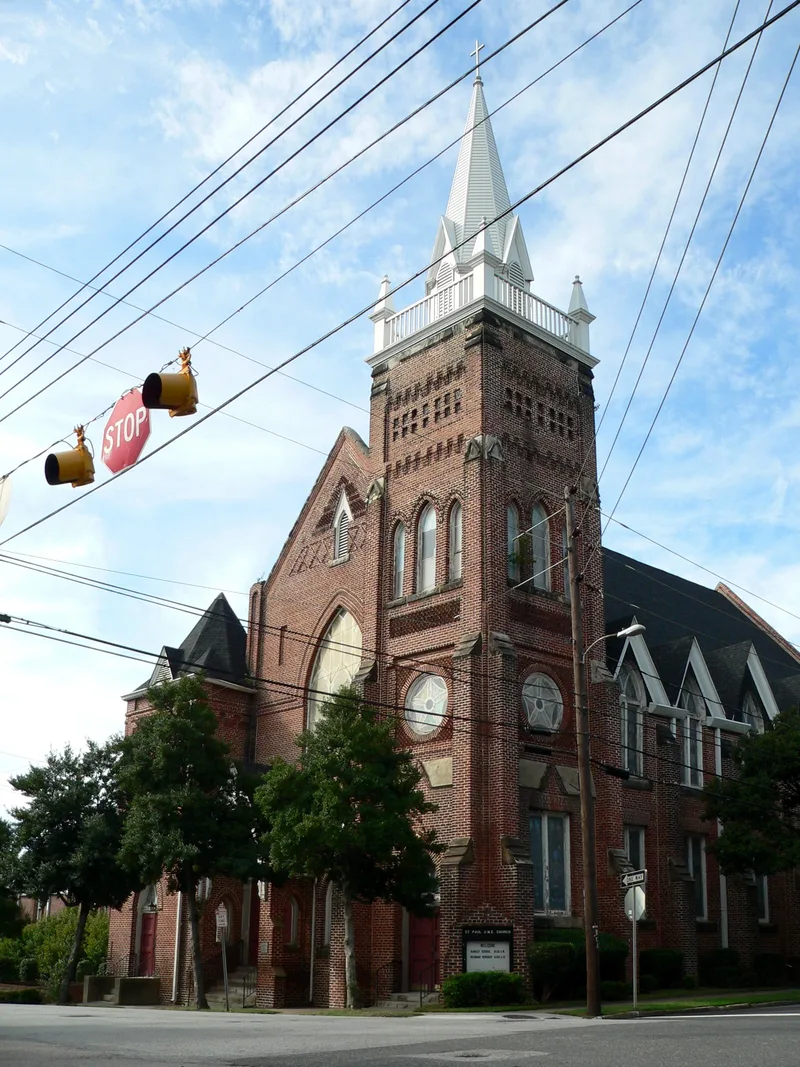
St. Paul A.M.E. Church is a red brick and wood Gothic Revival church on a corner lot in downtown Raleigh. Work began in 1884 and continued for decades, funded by a poor congregation whose members gave what they could and in some cases lost their homes to pay for materials. The building was nearly finished in July 1909 when a fire gutted it, and the congregation rebuilt within the surviving walls and rededicated it in 1910. The nearly square auditorium, wooden truss ceiling, gallery and Sunday School wing reflect Protestant adaptations of the Gothic style. Elaborate sawtooth and corbelled brickwork stands in for traditional stone tracery. The congregation, formed from the enslaved members of Edenton Street Methodist Church, joined the African Methodist Episcopal denomination in 1865. The church is recognized for its black-built masonry, its role in Reconstruction-era political gatherings, and pastors who became public figures.
Significance in brief: The nomination argues the church shows the excellence of black masons' craft in Raleigh, with elaborate brickwork and a vernacular interpretation of Gothic Revival. It was built by the first independent black congregation in Raleigh. Its pastors Henry Eppes, Stewart Ellison and R.W.H. Leak were important in the political and social history of the city and state.
Machine-generated summary. This summary was generated by a language model from the official nomination document and has not been reviewed line by line by an editor. It may contain errors. Check the source document before relying on any detail. Source: nomination document (PDF) · National Archives catalog entry. NRHP reference 80004607, listed November 5, 1987. Summary generated October 2026 (model claude-sonnet-5-5, prompt v1.0-2026-10-29, confidence high).
Key facts
| Address | 402 W. Edenton St., Raleigh |
|---|---|
| County | Wake County |
| Listed | November 5, 1987 |
| Reference number | 80004607 |
| Resource type | Building |
| Period of significance | 1884-1910 |
| Architect / builder | Ellison Leak et. al. |
| Architectural style | Late Gothic Revival (American Gothic Revival) |
| Criteria |
|
| Areas of significance | Black, Politics/Government, Architecture |
| Level of significance | Local |
| Status (as stated in the nomination) | Occupied and in use as a religious structure; described as very well preserved, with repointed mortar and a rebuilt southeast steeple cap, both about 1984. |
| Acreage | 0.9 |
| Coordinates | 35.78173, -78.64526 (NPS GIS) |
What listing means for this property
Religious properties are listed for their architectural or historical significance, not their religious use. Listing is honorary and does not restrict the congregation's use of the building. The federal rehabilitation credit is generally unavailable unless part of the building is income-producing; some state programmes and preservation grants do cover religious buildings. Federal funding or permits trigger Section 106 review.
General information, not legal or tax advice. Rules change; confirm with your State Historic Preservation Office or a qualified adviser.
Sources and further reading
- National Park Service, National Register of Historic Places database (snapshot May 2026), reference 80004607.
- Nomination form (PDF, National Archives) — catalog entry
- Wikipedia article (used for cross-checking only; text not reproduced here)
- Wikidata Q7591217
- This listing as JSON
Last updated October 2026. Found an error? See the editorial policy for how to report it.