Andrews-Duncan House

Why it's listed
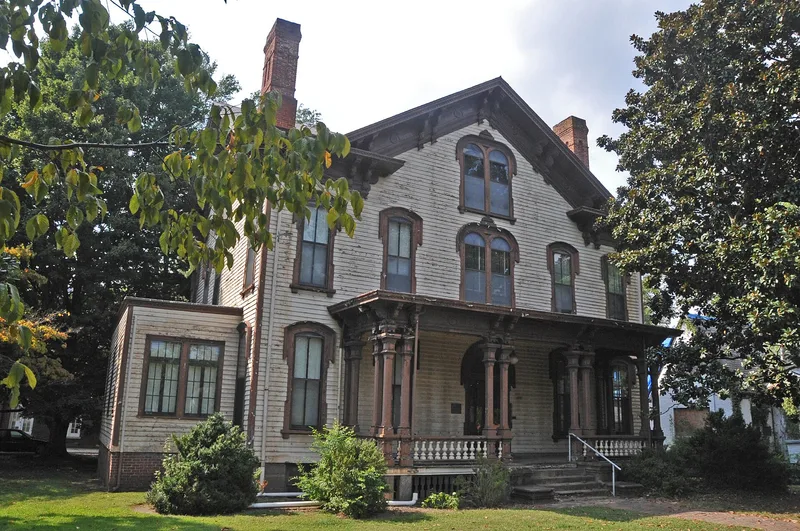
Located at 407 North Blount Street in Raleigh, this large two-and-one-half-story Victorian house has a gable roof, lapped siding and a coursed stone basement. The five-bay front has a porch with paired chamfered posts, ornate brackets and a central double door with etched glass. Inside, a modified center-hall plan holds a curving stair with octagonal balusters and parlors with marble mantels. Alexander Boyd Andrews, a railroad executive, bought the lot in 1873 and built the house. He began in railroading in 1859, became superintendent of the Raleigh and Gaston Railroad in 1867, and later served as first vice-president of the Southern Railway. Laura Duncan Pearson bought the house in 1919, and it stayed in the Duncan family. The yard holds the 'Henry Clay Oak', where Henry Clay is generally believed to have written his 1844 letter on the annexation of Texas. The house also recalls Blount Street's prominent families.
Significance in brief: It was built by one of the leaders of the nineteenth-century railroad business and is described as a fine example of a Victorian dwelling in the Italian mode. With the Heck-Andrews and Hawkins-Hartness houses it is a remnant of the days when Blount Street housed some of Raleigh's most prominent families. An old white oak in the yard, the 'Henry Clay Oak', is tied to Clay's 1844 'Texas Question' letter.
Machine-generated summary. This summary was generated by a language model from the official nomination document and has not been reviewed line by line by an editor. It may contain errors. Check the source document before relying on any detail. Source: nomination document (PDF) · National Archives catalog entry. NRHP reference 72000998, listed January 20, 1972. Summary generated October 2026 (model claude-sonnet-5-5, prompt v1.0-2026-10-29, confidence high).
Key facts
| Address | 407 N. Blount St., Raleigh |
|---|---|
| County | Wake County |
| Listed | January 20, 1972 |
| Reference number | 72000998 |
| Resource type | Building |
| Period of significance | 19th Century |
| Architectural style | Victorian dwelling in the Italian mode |
| Areas of significance | Transportation, Politics/Government, Architecture |
| Level of significance | State |
| Status (as stated in the nomination) | Condition marked good and altered, on its original site. Present use is listed as multiple dwelling. |
| Acreage | 1 |
| Within district | Oakwood Historic District |
| Coordinates | 35.78467, -78.63627 (NPS GIS) |
What listing means for this property
National Register listing is honorary for a privately owned home: it does not by itself restrict what an owner may do with their own money, and it does not require public access. Restrictions come from local landmark or historic-district ordinances, which are separate (how they differ).
Owner-occupied houses are not eligible for the 20% federal rehabilitation tax credit, which applies to income-producing buildings, but many states offer credits for homeowners. Listing also opens the door to preservation easements and to buying a plaque. Start with what listing means for homeowners, renovating a listed house and selling one.
General information, not legal or tax advice. Rules change; confirm with your State Historic Preservation Office or a qualified adviser.
Sources and further reading
- National Park Service, National Register of Historic Places database (snapshot May 2026), reference 72000998.
- Nomination form (PDF, National Archives) — catalog entry
- Wikipedia article (used for cross-checking only; text not reproduced here)
- Wikidata Q18640106
- This listing as JSON
Last updated October 2026. Found an error? See the editorial policy for how to report it.