Planters Building
Also known as: First Union Bank Building

Why it's listed
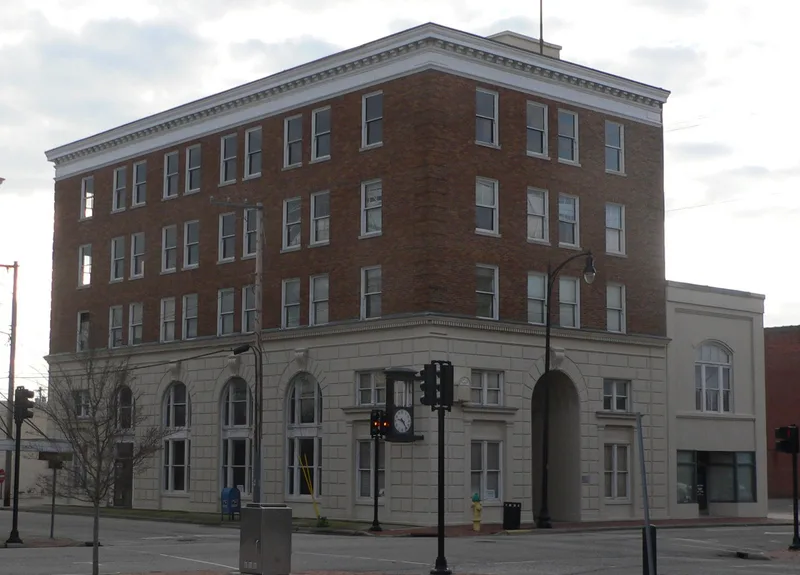
Rising five stories at the corner of Chestnut and Fourth Streets in Lumberton, this steel-framed Classical Revival building was designed as a bank with leased offices above. Completed in 1925-26 for the Planters Building Corporation, backed by Planters Bank & Trust, it cost about $115,000 and had steam heat and one of two electric elevators in town. The street fronts are faced with rusticated cast concrete and tall arched windows below orange tapestry brick, topped by a bracketed sheetmetal cornice. Inside, a two-story banking room has colossal piers, a coffered ceiling, pink marble wainscot and terrazzo floors. The architects were Wilson, Berryman and Kennedy, a branch of Charles Coker Wilson's South Carolina practice. The building was listed because it reflects Lumberton's growth as a railroad, cotton and tobacco market town in the early twentieth century, and because it is a well-preserved, large-scale example of Classical Revival design in a small eastern North Carolina town. The bank later changed hands, and the building has been vacant since the 1980s.
Significance in brief: The nomination argues it is the most prominent surviving expression of Lumberton's commercial and physical boom in the early twentieth century and one of only a handful of high-rise buildings built in eastern North Carolina in that period. It is also a well-preserved example of Classical Revival design, with a luxuriously finished two-story banking room, by the firm Wilson, Berryman and Kennedy, led by Charles Coker Wilson.
Machine-generated summary. This summary was generated by a language model from the official nomination document and has not been reviewed line by line by an editor. It may contain errors. Check the source document before relying on any detail. Source: nomination document (PDF) · National Archives catalog entry. NRHP reference 87001913, listed November 3, 1987. Summary generated October 2026 (model claude-sonnet-5-5, prompt v1.0-2026-10-29, confidence high).
Key facts
| Address | 312 N. Chestnut St., Lumberton |
|---|---|
| County | Robeson County |
| Listed | November 3, 1987 |
| Reference number | 87001913 |
| Resource type | Building |
| Period of significance | 1925-26 |
| Architect / builder | Wilson, Berryman and Kennedy (architects); J. F. Beaman Construction Company of Raleigh (contractor) |
| Architectural style | Classical Revival |
| Criteria |
|
| Areas of significance | Commerce, Architecture |
| Level of significance | Local |
| Status (as stated in the nomination) | The building has been vacant since shortly after 1983, when First Union National Bank ended its operations there. A adjoining former telephone company building is a noncontributing addition. |
| Acreage | 0.9 |
| Within district | Lumberton Commercial Historic District |
| Coordinates | 34.61916, -79.00764 (NPS GIS) |
What listing means for this property
For an income-producing building, listing (individually or as a contributing building in a district) is the gateway to the 20% federal rehabilitation tax credit on qualified rehabilitation costs, often stackable with state credits. Work claiming the credit must follow the Secretary of the Interior's Standards and be approved in advance.
Listing does not restrict a private owner acting without federal money or permits; where federal funding or licensing is involved, Section 106 review applies.
Noted as vacant in the nomination. Nomination documents can be decades old; current status may differ. If you are considering buying an empty listed property, read the due-diligence checklist.
General information, not legal or tax advice. Rules change; confirm with your State Historic Preservation Office or a qualified adviser.
Sources and further reading
- National Park Service, National Register of Historic Places database (snapshot May 2026), reference 87001913.
- Nomination form (PDF, National Archives) — catalog entry
- Wikipedia article (used for cross-checking only; text not reproduced here)
- Wikidata Q19987599
- This listing as JSON
Last updated October 2026. Found an error? See the editorial policy for how to report it.