Carolina Theatre
Carolina Theatre is a building in Lumberton, Robeson County, North Carolina, listed on the National Register of Historic Places on July 9, 1981 (reference number 81000426). The National Park Service records its significance in Entertainment/Recreation, Architecture and Social History at the local level.
Facts from the NPS National Register database (); nomination summary October 2026. Last updated . Sources for each fact.

Approximate location: the National Park Service places this pin arbitrarily within the property, not at a surveyed point (stated accuracy ±12 m).
Why it's listed
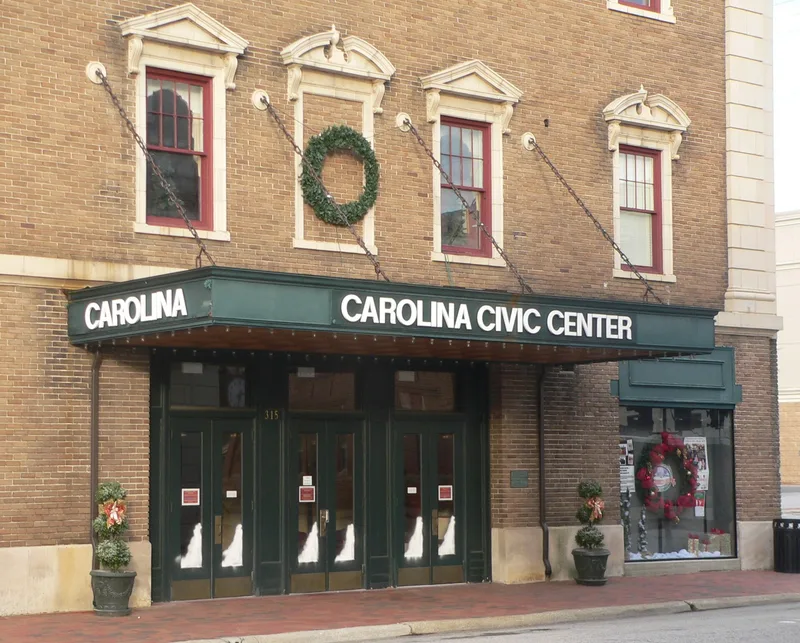
Built in 1927-1928 at the corner of Chestnut and Fourth streets in Lumberton, the Carolina Theatre combined a movie house with doctors' offices in a three-story brick and terra cotta building. S. S. Dixon of Fayetteville designed it in the Italian Renaissance style, with rusticated pilasters, terra cotta quoins and a balustraded parapet topped by urns. The U. A. Underwood Construction Company of Wilmington built it for a stock company led by two local doctors. It opened on June 18, 1928, and talking pictures arrived in March 1929. For decades it was the town's main movie house and a stage for vaudeville, variety shows and touring acts. A 1940 remodeling added a neon marquee and a flyloft. The theater closed in 1975, and local citizens then pushed to save it for performing arts use. The building is valued as a social and cultural center and as an example of 1920s movie palace design.
Significance in brief: It served as Lumberton's principal movie house and entertainment center from 1928 until it closed in 1975, hosting silent films, vaudeville, talking pictures and road shows. It is also considered one of the most accomplished classically influenced buildings in the town's early 20th century business district, typical of 1920s movie palace design.
Machine-generated summary. This summary was generated by a language model from the official nomination document and has not been reviewed line by line by an editor. It may contain errors. Check the source document before relying on any detail. Source: nomination document (PDF) · National Archives catalog entry. NRHP reference 81000426, listed July 9, 1981. Summary generated October 2026 (model claude-sonnet-5-5, prompt v1.0-2026-10-29, confidence high).
Key facts
| Official database NPS National Register database, ref. 81000426 , checked | |
|---|---|
| Address | 319 N. Chestnut St., Lumberton |
| County | Robeson County |
| Listed | July 9, 1981 |
| Reference number | 81000426 |
| Resource type | Building |
| Areas of significance | Entertainment/Recreation, Architecture, Social History |
| Level of significance | Local |
| National Historic Landmark | No |
| Acreage | 0.9 |
| Official document, machine-extracted Nomination form (National Archives) , checked | |
| Period of significance | 1927-1928 |
| Architect / builder | S.S. Dixon, Architect; U.A. Underwood Construction Co., Contractor |
| Architectural style | Italian Renaissance |
| Criteria |
|
| Status (as stated in the nomination) | Listed as vacant and owned by the City of Lumberton at the time of the form; the theater closed in 1975 and condition is given as good and altered. |
| Official dataset NPS cultural-resource GIS (NRHP locations) | |
| Coordinates | 34.61925, -79.00796 |
| Computed Computed from NPS GIS district boundaries | |
| Within district | Lumberton Commercial Historic District |
What listing means for this property
For an income-producing building, listing (individually or as a contributing building in a district) is the gateway to the 20% federal rehabilitation tax credit on qualified rehabilitation costs, often stackable with state credits. Work claiming the credit must follow the Secretary of the Interior's Standards and be approved in advance.
Listing does not restrict a private owner acting without federal money or permits; where federal funding or licensing is involved, Section 106 review applies.
Noted as vacant in the nomination. Nomination documents can be decades old; current status may differ. If you are considering buying an empty listed property, read the due-diligence checklist.
General information, not legal or tax advice. Rules change; confirm with your State Historic Preservation Office or a qualified adviser.
Questions about Carolina Theatre
When was Carolina Theatre added to the National Register of Historic Places?
Carolina Theatre was listed on July 9, 1981. Its National Register reference number is 81000426.
Is Carolina Theatre a National Historic Landmark?
No. The National Park Service database (snapshot of May 2026) lists Carolina Theatre on the National Register but does not record it as a National Historic Landmark.
Where is Carolina Theatre?
319 N. Chestnut St., Lumberton, Robeson County, North Carolina; coordinates 34.61925, -79.00796.
Why is Carolina Theatre historically significant?
According to a machine-generated summary of its nomination form: It served as Lumberton's principal movie house and entertainment center from 1928 until it closed in 1975, hosting silent films, vaudeville, talking pictures and road shows. It is also considered one of the most accomplished classically influenced buildings in the town's early 20th century business district, typical of 1920s movie palace design. Check the nomination document before relying on any detail.
Who designed or built Carolina Theatre?
The nomination form names S.S. Dixon, Architect; U.A. Underwood Construction Co., Contractor as architect or builder (extracted by machine from the nomination; check the source document).
Is Carolina Theatre in a historic district?
Yes. Its location falls within the Lumberton Commercial Historic District, itself listed on the National Register. (Computed from National Park Service boundary data; the district nomination's own list of contributing resources may differ.)
Where can I read the original nomination for Carolina Theatre?
The nomination form is a public record held by the National Archives: nomination document (PDF).
Sources and further reading
- National Park Service, National Register of Historic Places database (snapshot May 2026), reference 81000426.
- Nomination form (PDF, National Archives) — catalog entry
- Wikipedia article (used for cross-checking only; text not reproduced here)
- Wikidata Q19871906
- This listing as JSON
Last updated November 2026. Found an error? See the editorial policy for how to report it.